The human stakesT2 · external source
Hydrocephalus — cerebrospinal fluid accumulating in the brain — is managed by a shunt: a tube draining excess fluid, governed by a valve. The clinical record is sobering: a large adult cohort study reports shunt failure rates ran as high as 32% (US, 1990–2009), with first-year revision rates around 17–21% in national registries (UK/Ireland 17.4%, Norway 20.7%), and long-term shunt survival far from assured — one comparative series saw only 81% of shunts still working at one year (PMC retrospective cohort, PMC comparative study, accessed 2026-07-22; figures corrected after adversarial QA). Each failure can mean another brain surgery.
Honest framingT2 · external source
Most failures are obstruction or infection rather than the valve mechanism — but valves are not blameless: in one pediatric series, first-generation programmable valves showed an ~11%-per-year intrinsic malfunction rate (9 of 35 revisions in the programmable group were the valve itself), where comparable non-programmable valves showed none (PubMed). So valve technology is one lever among several — and programmability's core promise is real: adjusting drainage pressure transcutaneously instead of by revision surgery.
The inventionT1 · from the patentUS11701503B2
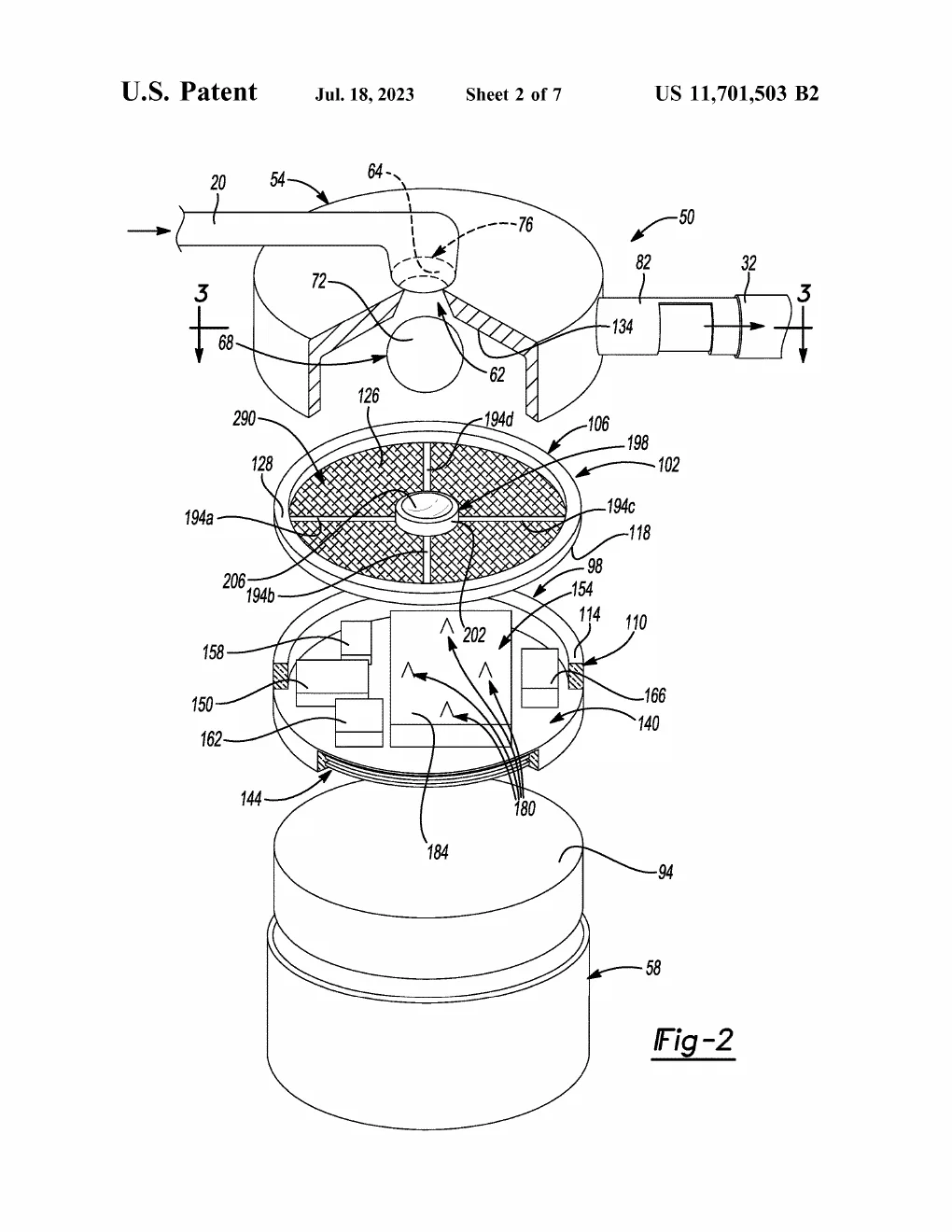
The line (Medtronic PS Medical, the hydrocephalus division) claims a flow control assembly governed as a system: a flow-regulating shunt whose valve is driven by a MEMS (micro-electro-mechanical) actuator, controlled "according to selected parameters and methods" — pressure regulation as a control loop rather than a fixed spring setting. Two grants (2023, 2024) plus a continuing 2024 application mark an active line.
Plain-English registerT3 · interpretationconfidence: high
Old valves are like a fixed door-closer: one stiffness, chosen at surgery. This is a door with a tiny motorized hinge and a thermostat's brain — it can be told, from outside the body, exactly how hard to resist.
Why it belongs in the flagship setT3 · interpretationconfidence: medium
It shows the corpus's range: the same engineer whose name anchors nanometer bonds and radiation sponges also works where the engineering meets its most vulnerable patients. And it demonstrates the packaging thesis applied — a MEMS actuator can only live in CSF because the sealing craft exists. Inference, clearly labeled: we have no public evidence tying these patents to a shipped valve product; what's documented is the clinical need and the claimed mechanism.
Set-piece note (for Presentation)T3 · interpretation
Quietest set-piece on the site, deliberately: a slow pressure trace across the screen — rising toward a red band — then the MEMS valve opens a hair's width, the trace settles back to green. No spectacle. Just a system, keeping a child out of the operating room. Let the restraint carry the emotion.