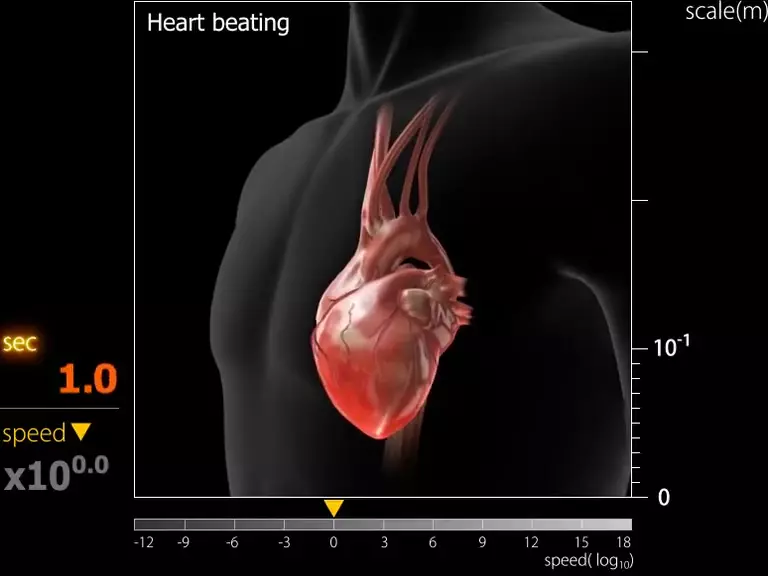
Begin where he began: a muscle that will not pause while the parts are counted — and a box that must keep up for a decade.
Movie 1. Heart beating, National Institute of Genetics, CC BY 3.0, via Wikimedia CommonsThe problem By the early nineties the pacemaker’s body was a “clam shell” — two halves butt-welded around the electronics, with weld rings to protect them and separate plastic cups to hold every component in place. Many parts, many steps, many chances for error.
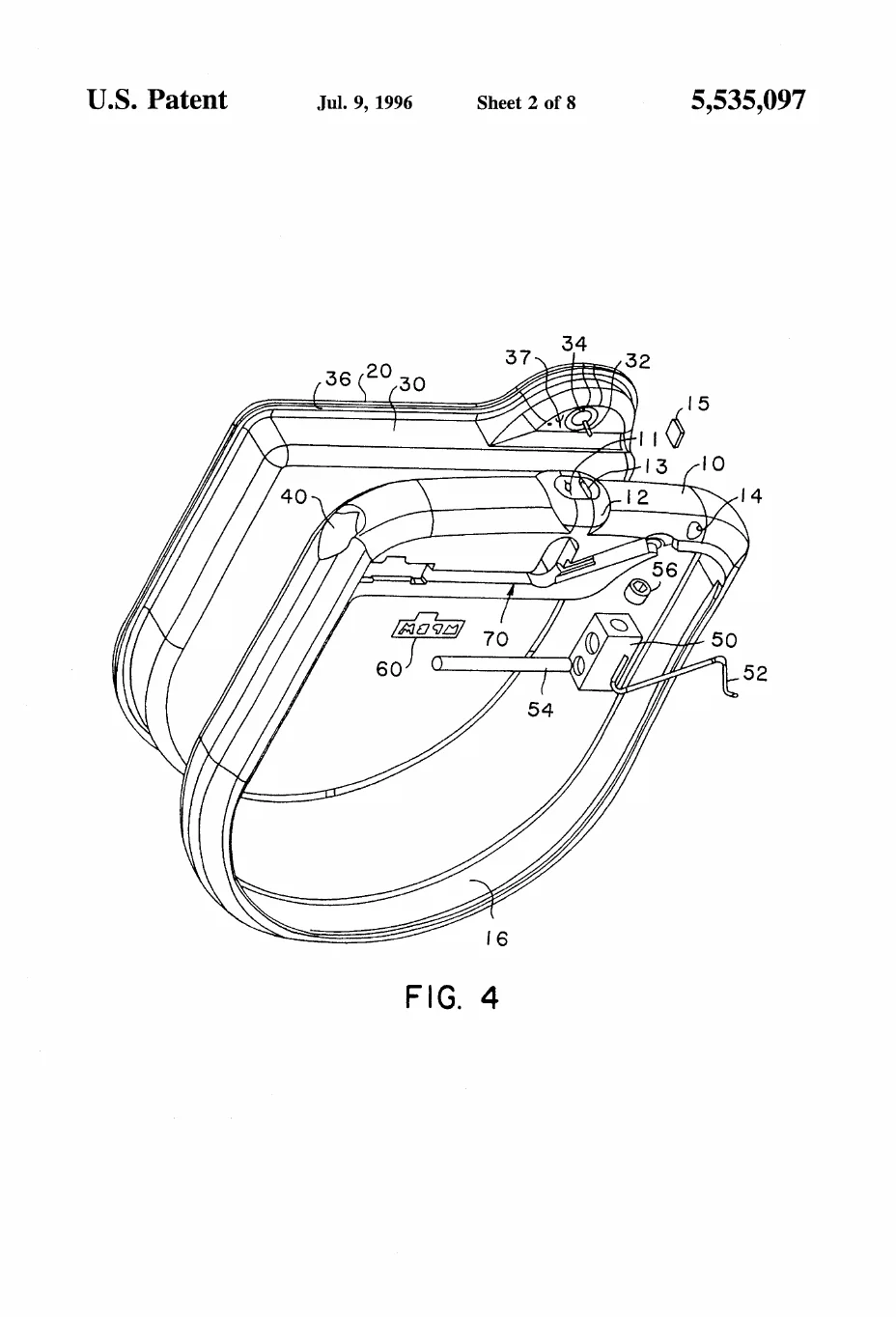
A perspective assembly view with the lid half pulled away from the main shell, exposing the connector hardware between them — the connector block, setscrew, spring contact, feedthrough pin, and sealing plug all floating in their positions like a freeze-frame of the device being put together.
United States Patent and Trademark Office · public domainThe origin pointT1 · from the patentUS5535097A
Filed November 23, 1993 — the earliest patent in the corpus, with David A. Ruben first on the inventor list. The subject could not be more foundational: the pacemaker's body itself — the hermetic housing, and the connector module that joins it to the lead running into the heart.
The problemT1 · from the patentUS5535097A
The background section is a compact history of pacemaker construction: discrete components potted in epoxy; then sealed metal cans. By the early '90s the standard was a "clam shell" — two halves butt-welded around the electronics, requiring weld-ring protection and separate plastic cups to position components. Many parts, many steps, many chances for error.
Why “sealed” is a number, not a feeling: every step down this scale is ten times tighter, and the implant lives far past where a soap bubble — or a helium sniffer — could tell you anything at all.
An original instrument of the houseThe principleT1 · from the patentUS5535097A
Redesign the enclosure so the parts locate themselves. Claim 1: a first enclosure portion with a planar lower interior surface and a stepped second interior surface; battery and circuit mounted adhesively; connections made by wire bonding (chip-industry technique, not hand-soldered wires); the feedthrough passing through the stepped surface; a second portion completing the hermetic seal. (The molded resilient shroud forming the connector module is the abstract's summary — in the claims it is claim 3's connector module "mounted to said circumferential edge surface.") Claimed result: "fewer components and fewer manufacturing steps," lower cost, and a "smooth, rounded contour" kinder to the tissue pocket it lives in.
Plain-English registerT3 · interpretationconfidence: high
Instead of building a box and then engineering trays to hold everything, shape the box's interior so each part has one obvious seat — then close the lid once. Fewer pieces, fewer welds, fewer ways to fail.
Measured influenceT1 · from the patentUS5535097A
Google Patents lists 100 citing patents — among the most-cited work in the corpus (only the accelerometer line's members rank higher) — meaning a hundred later inventions found this design foundational enough to cite as prior art.
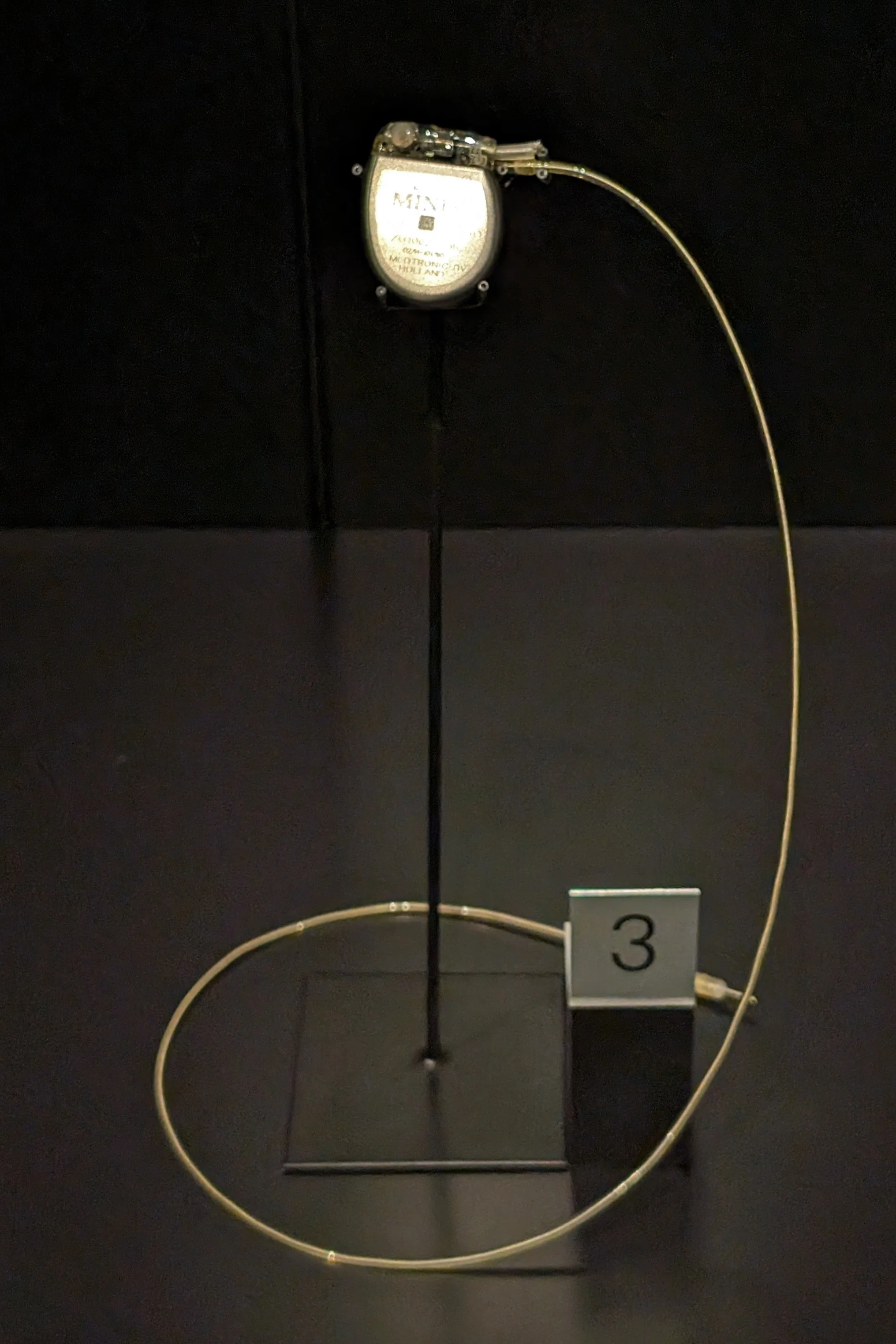
A Medtronic pacemaker of 1993 — the year of the first filing — kept now under museum glass, the way this movement keeps the drawings.
The wub, CC BY-SA 4.0, via Wikimedia CommonsWhy it matters to the storyT3 · interpretationconfidence: high
Every theme of the next three decades is already present in this one 1993 filing: hermeticity as the prime constraint, manufacturability as a design input, borrowing microelectronics techniques into medical devices, and volume efficiency as mercy on the patient. The corpus doesn't wander — it deepens. This is the seed.
Supporting Plates
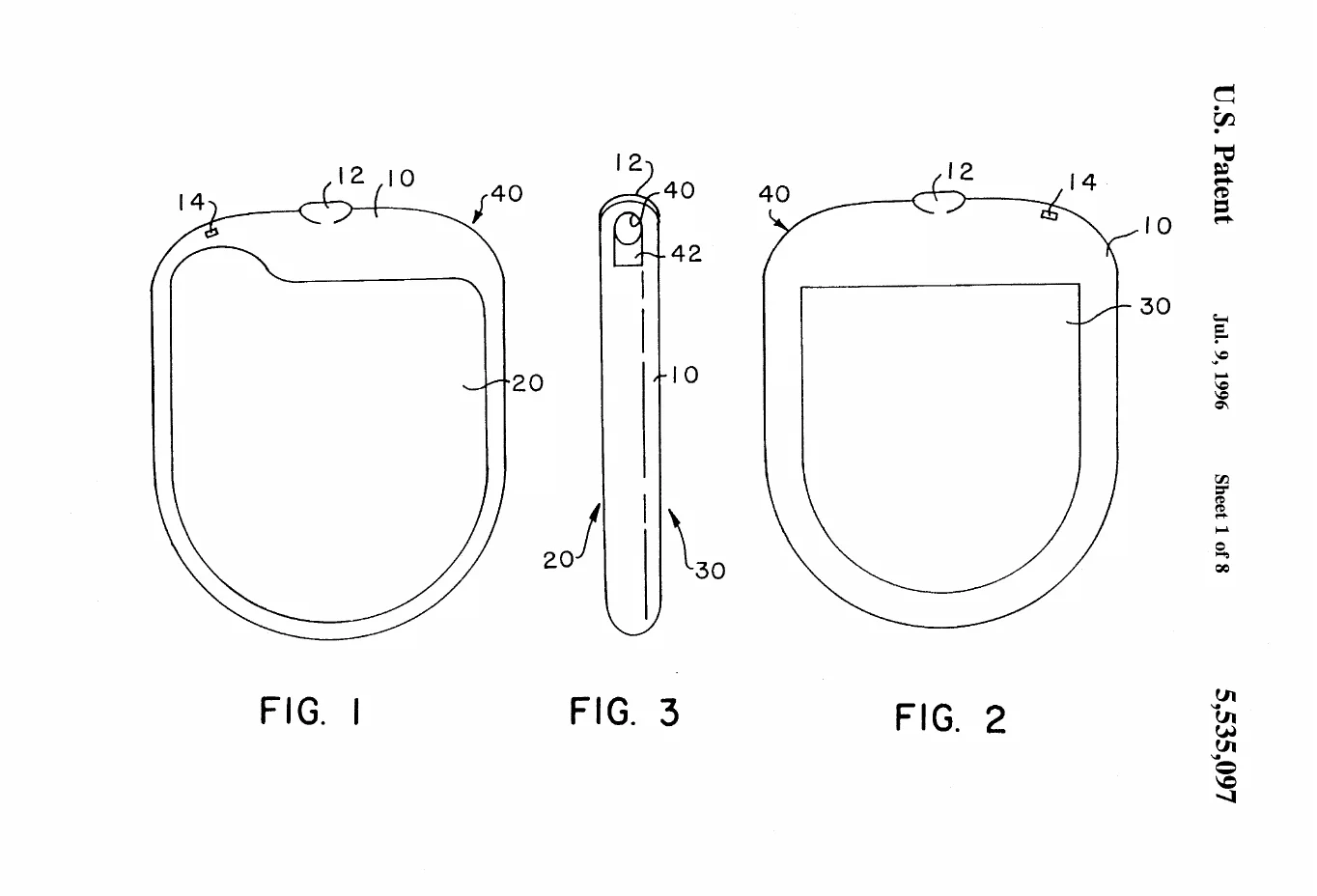
Three plain outline views of the finished pacemaker can — front, back, and razor-thin edge-on — establishing its rounded D shape, the connector bore at the top corner, and the feedthrough spot on the rim.
United States Patent and Trademark Office · public domain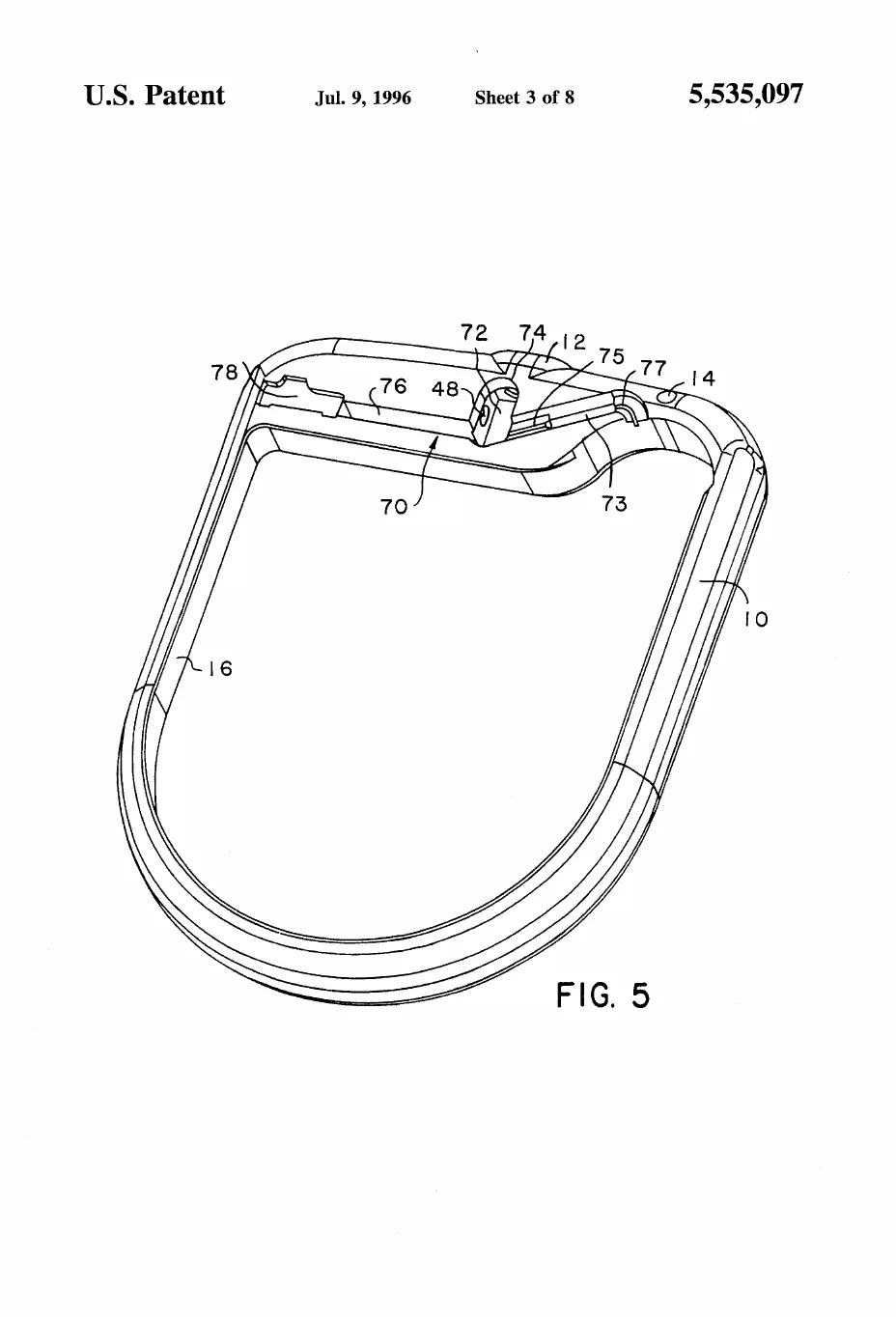
The open main shell viewed from above with the lid removed, showing the stepped interior ledge along the top edge where the feedthrough and connector parts seat themselves — the self-locating geometry at the heart of the claim.
United States Patent and Trademark Office · public domainA hundred later inventions cite this housing. Every theme of the next three decades is already inside it.