A monograph in patents · 1993–2026
The Sealed
Machine
For thirty-three years, while the medical-device industry argued about what an implant should think, David A. Ruben worked one layer down — on the seam that decides whether any of it survives the body at all.
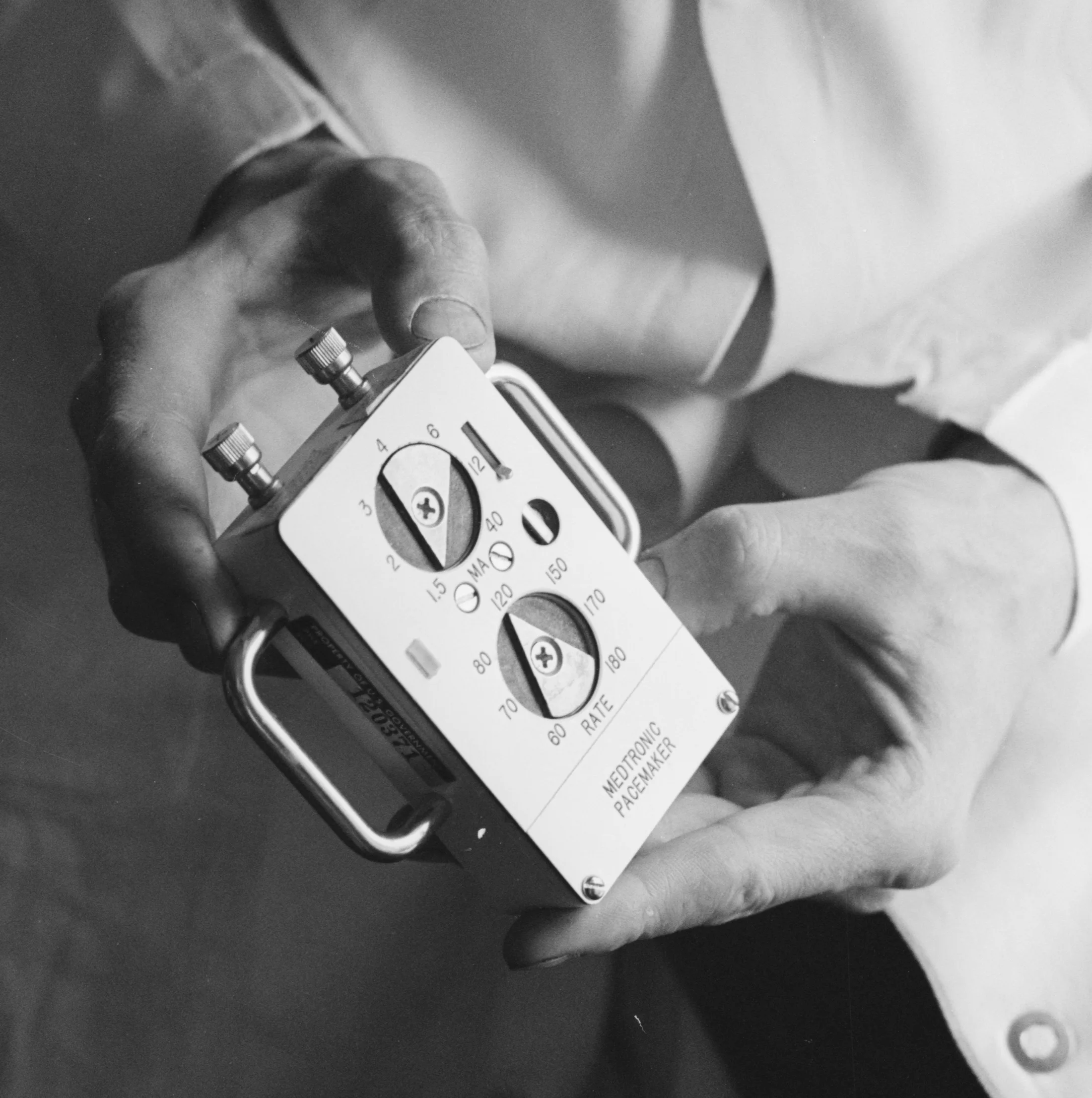
Nineteen sixty-one. The machine still lived outside the body, and hands still reached in to tune it. Everything after is the story of sealing those hands’ work away.
Warren K. Leffler, U.S. News & World Report Magazine Photograph Collection, Library of Congress — public domain, via Wikimedia CommonsHis work is cited as prior art by Boston Scientific, BIOTRONIK, Verily, Lockheed Martin, and IBM, among a hundred others.
Every grant in the corpus, plotted by its year — a stream that starts in 1996 and is still running in 2026. Brass marks the flagship of a line.
An original instrument of the atelierThe World He Was Handed
The world of his first patent was already rigidly canonical. By the mid-1980s the implantable pulse generator had a fixed anatomy: a titanium can laser-welded from stamped halves; a feedthrough crossing the hermetic wall through a glass-to-metal seal; and inside, the lithium-iodine battery that had stretched device life from two years to ten. Above that hardware raged the era’s glamorous contest — rate response, the race to let a pacemaker sense exertion — and nearly everyone wanted in.
Ruben entered beneath that race, not in it. His first filing, in November 1993, could not be more foundational: the pacemaker’s body itself. Where the standard “clam shell” demanded weld-ring protection and separate plastic cups to position every component, US5535097A reshapes the enclosure so the parts locate themselves — a stepped interior seat for battery and circuit, wire bonds borrowed from the chip industry, one lid closed once. Fewer pieces, fewer welds, fewer ways to fail. A hundred later inventions would cite it.
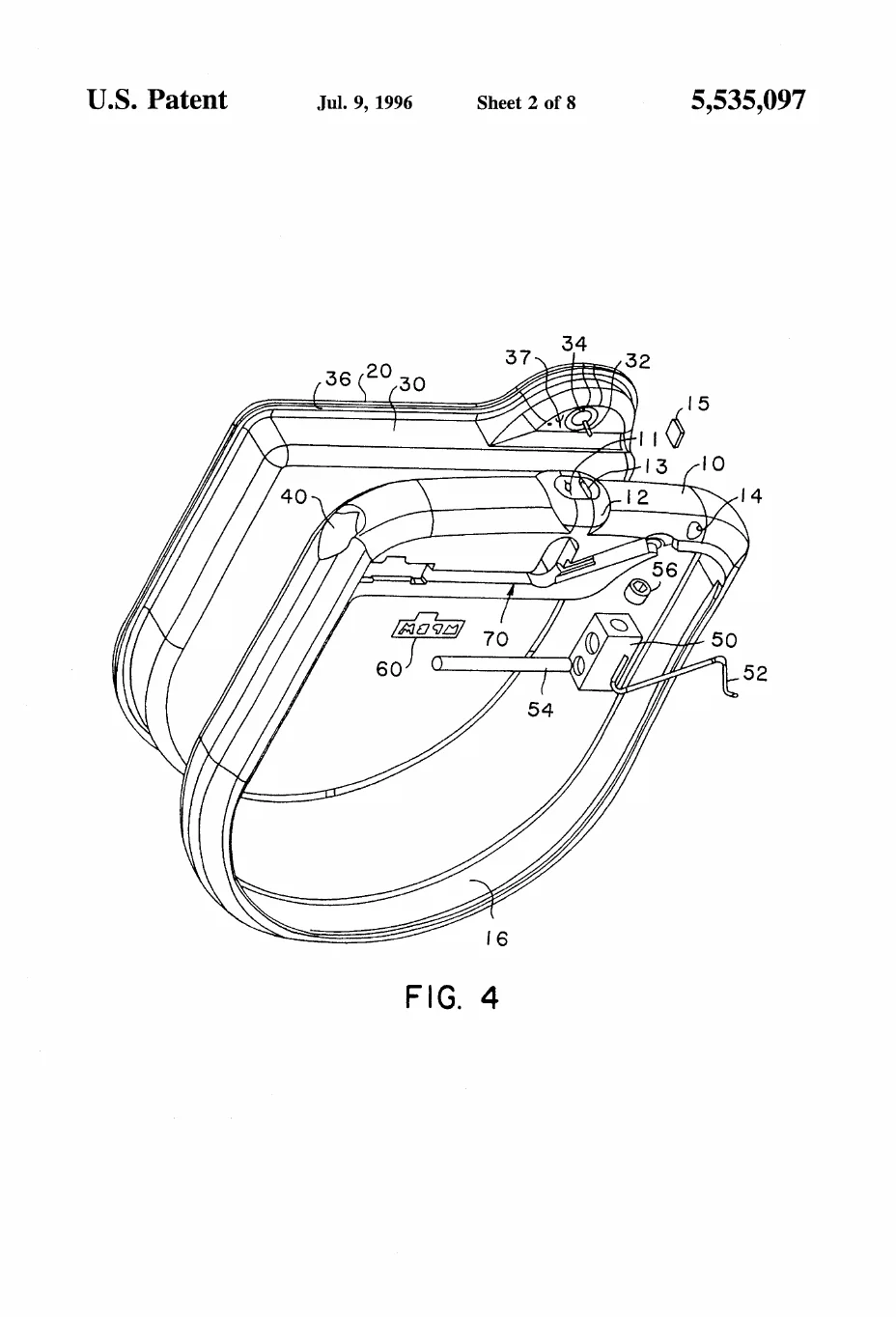
A perspective assembly view with the lid half pulled away from the main shell, exposing the connector hardware between them — the connector block, setscrew, spring contact, feedthrough pin, and sealing plug all floating in their positions like a freeze-frame of the device being put together.
United States Patent and Trademark Office · public domainThe same instinct runs through the rest of the decade. When Medtronic’s own devices moved from piezo crystals listening for footfall to true accelerometers, Ruben didn’t bet on which sensor would win the clinical argument — he made the winning answer buildable. US5885471A is the beam-stop that kept a fragile piezoelectric cantilever from snapping when the device was dropped; with 203 citations it is the most-cited work in the corpus. US6216537B1 stood the sensing axis upright in a surface-mount package so the part could ride a standard assembly line.
Unglamorous work, on its face. But it is the kind everything else stands on — and it set the pattern of the whole career: while others argued about how the machine should think, he made sure it could be built, sealed, and trusted for a decade in warm salt water.
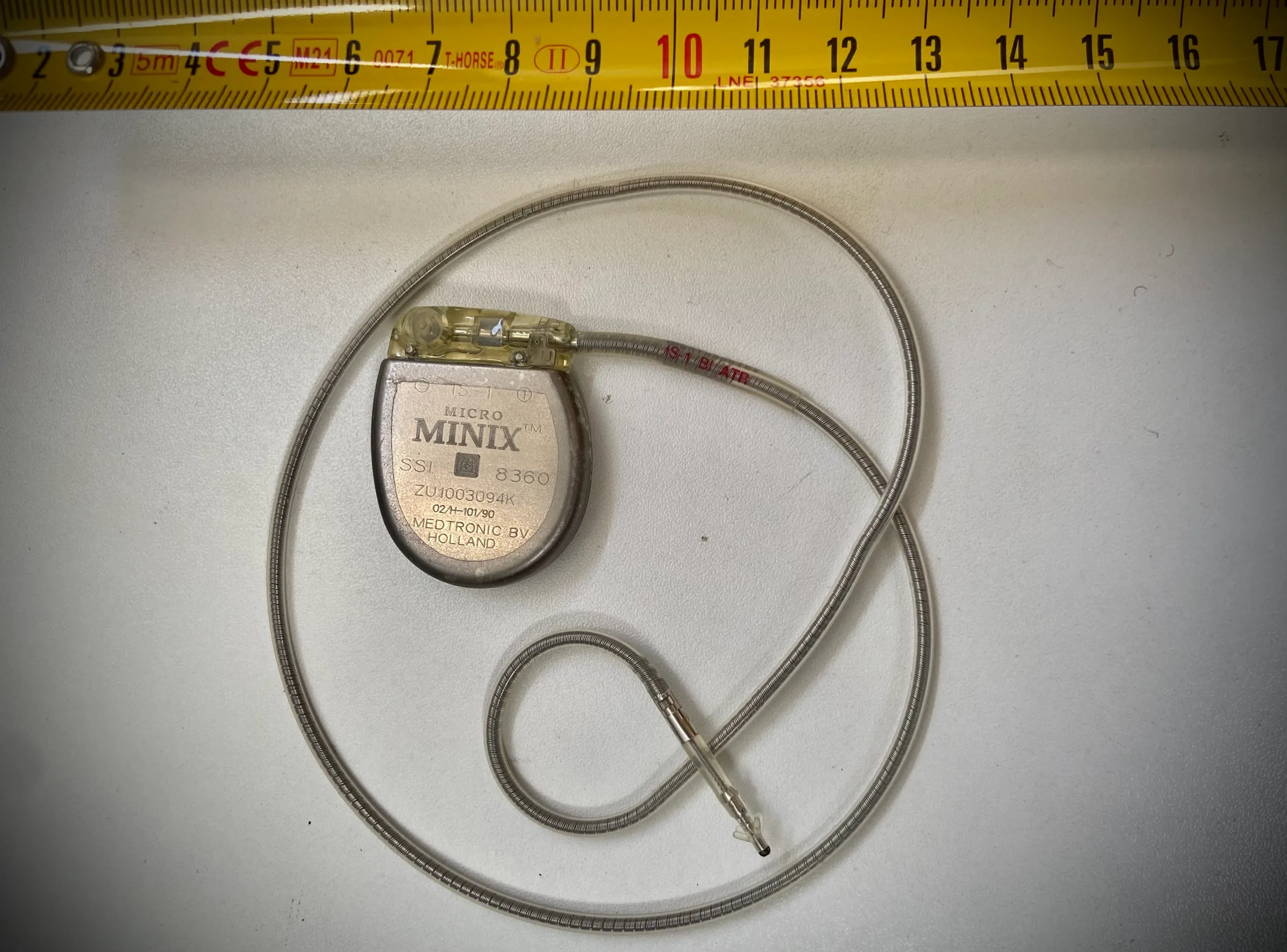
The artifact itself: a laser-welded titanium can, its lead coiled like a signature. Nothing leaks in; nothing leaks out.
Kuroczynski, CC BY-SA 4.0, via Wikimedia CommonsThe Package Follows the Battery Down
Around 2010 the comfortable shrink-schedule broke against a wall made of volume. A pacemaker’s logic follows Moore’s law; its battery and hermetic package do not. Energy is set by chemistry and geometry, so shrinking the device tenfold makes the can wall, the weld seam, and the feedthrough header a punishing fraction of a one-cubic-centimeter implant. Medtronic’s leadless Micra — a 0.8 cc, two-gram pill dropped straight into the right ventricle — reached a first human in December 2013. Someone had to make a package that small even thinkable.
The technique that could was wafer-level packaging — sealing thousands of devices in parallel on the wafer, imported from consumer electronics. It came with a fatal catch: its classic bonding steps run at 400–1100 °C, and would cook any battery sealed inside. This is the seam Ruben’s mid-career work runs straight down. US8666505B2 — priority October 2010, three years before Micra’s first implant — folds control module and energy source into one wafer-scale cavity sealed at no more than 200 °C, explicitly naming leadless form factors. Its continuation, US9318400B2, carries the corpus’s highest measured influence: 151 citing patent families.
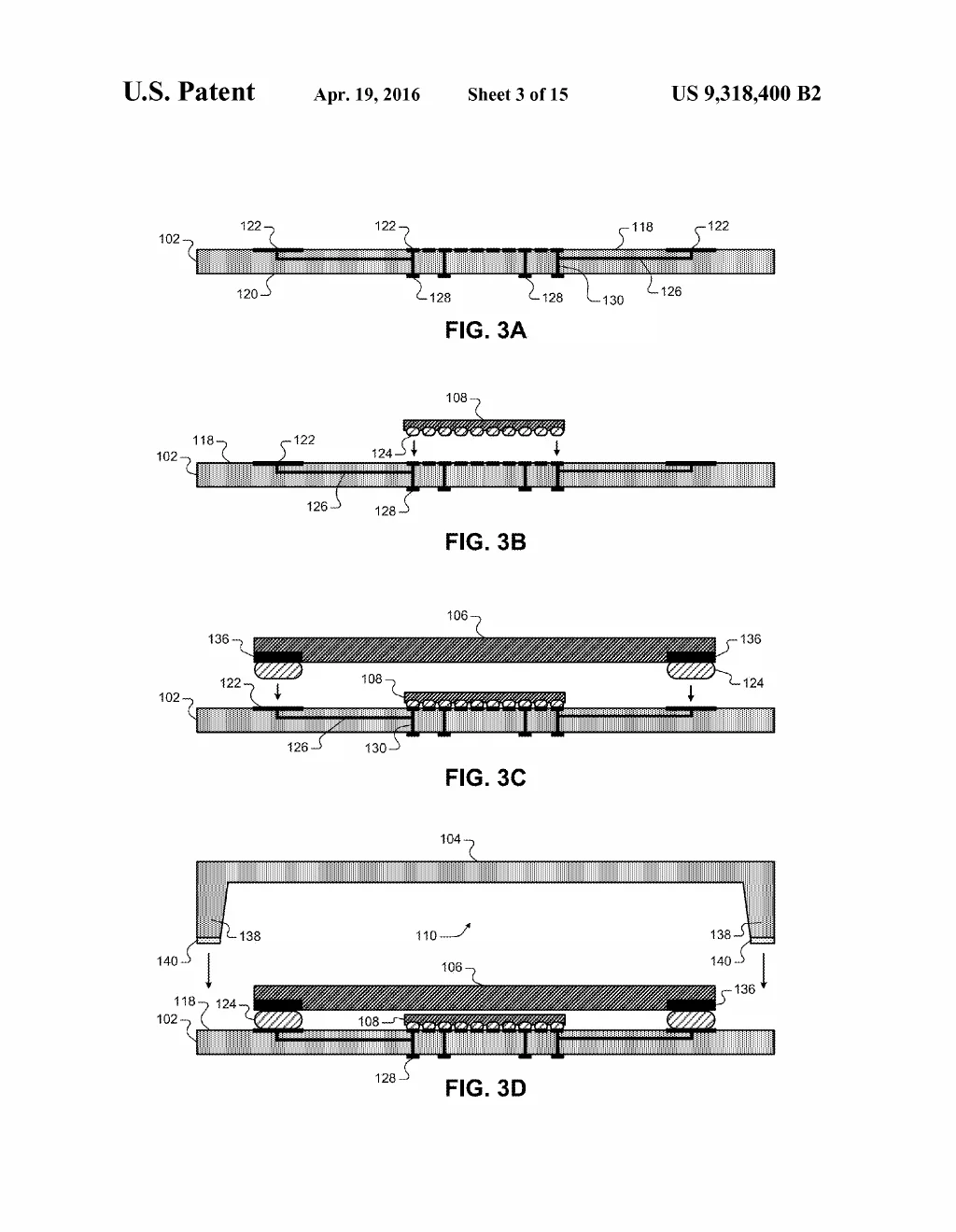
A four-step assembly sequence in cross-section: the bare wired substrate, the chip lowered onto its solder balls, the battery lowered onto its pads, and finally the recessed glass cap descending over both to enclose them in a cavity for bonding.
United States Patent and Trademark Office · public domainAnd the laser weld — heat put exactly where the joint is and nowhere else — dissolves the cook-the-battery dilemma entirely. The priority dates show him writing the transition down while the race was still forming.
A pulsed laser closes a hermetic can the way a sewing machine closes a seam: each round pulse melts a spot that overlaps the last, and the beam moves on before the heat can reach what the can protects.
An original instrument of the atelierThe implant shrank from a matchbox to a pill. The seam had to shrink with it — without ever getting hot.
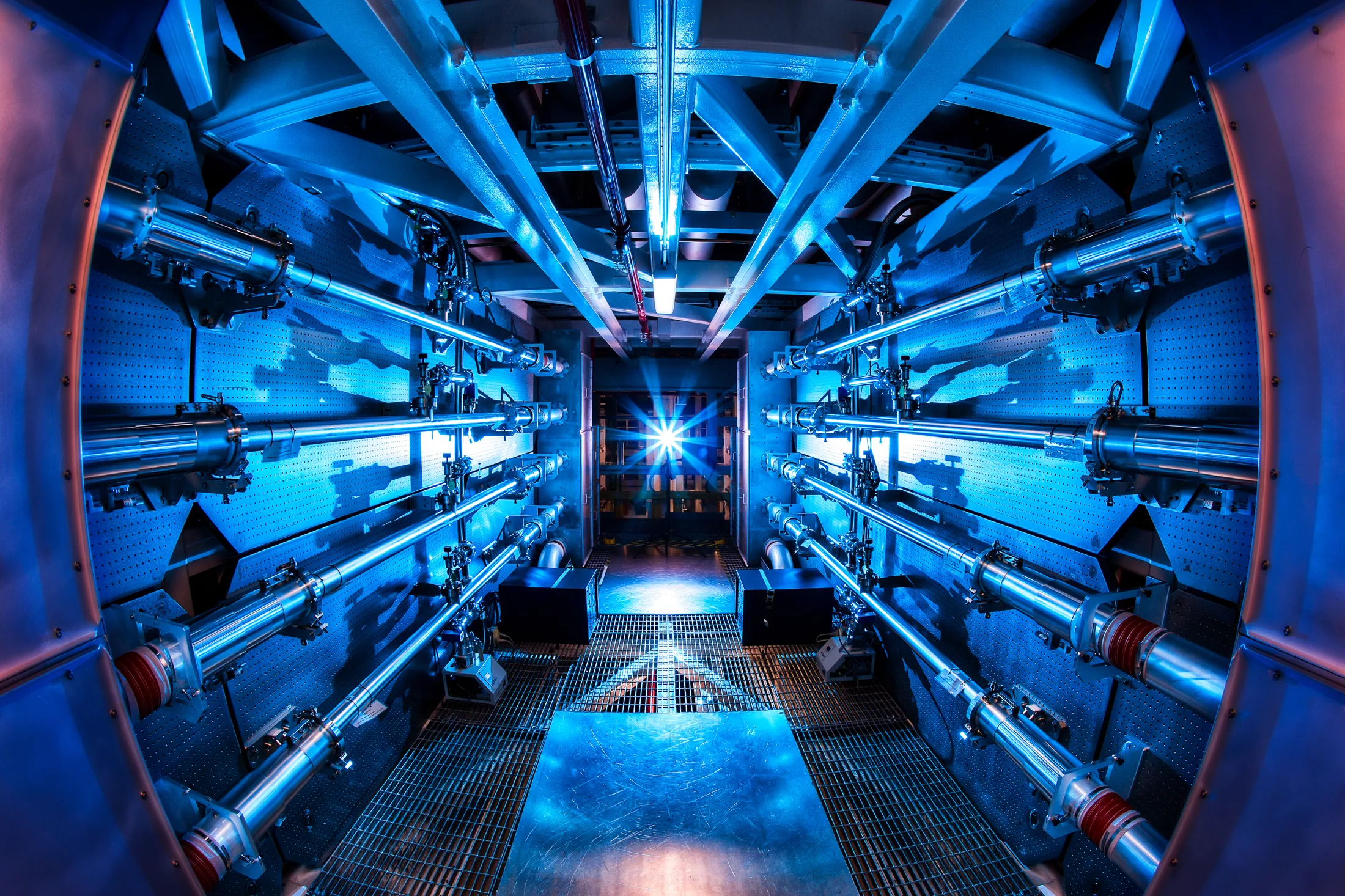
Light, disciplined, is a tool. The craft is deciding exactly where it is allowed to become heat.
Photo: Lawrence Livermore National Laboratory, via Wikimedia Commons, CC BY-SA 3.0The Roads Not Taken
Every problem Ruben attacked had a dominant incumbent solution — and he repeatedly declined the simplest robust one for the harder option demanding more sealing, more power, more control. The pattern is the signature. Feedthroughs belonged to co-fired ceramic and glass-to-metal seals, proven across tens of millions of devices — but both apply heat, late, to a part that must therefore be empty. His laser-bonded feedthrough line trades batch-oven throughput for the ability to seal a package already full of electronics and a live battery.
In pressure sensing, CardioMEMS chose a fully passive resonator — no battery, no wire crossing the body — and won a large clinic. Ruben’s US8424388B2 keeps an amplifier awake inside, buying precision at the exact cost the passive design was built to avoid. In rate response, his accelerometer bet durability over physiologic fidelity — a trade the field ultimately hedged with dual-sensor blends. And against the fixed and magnetically programmable valves that own the hydrocephalus market, US11701503B2 pushes toward a MEMS closed-loop actuator — re-importing every electronics-in-fluid problem the rest of his corpus exists to solve.
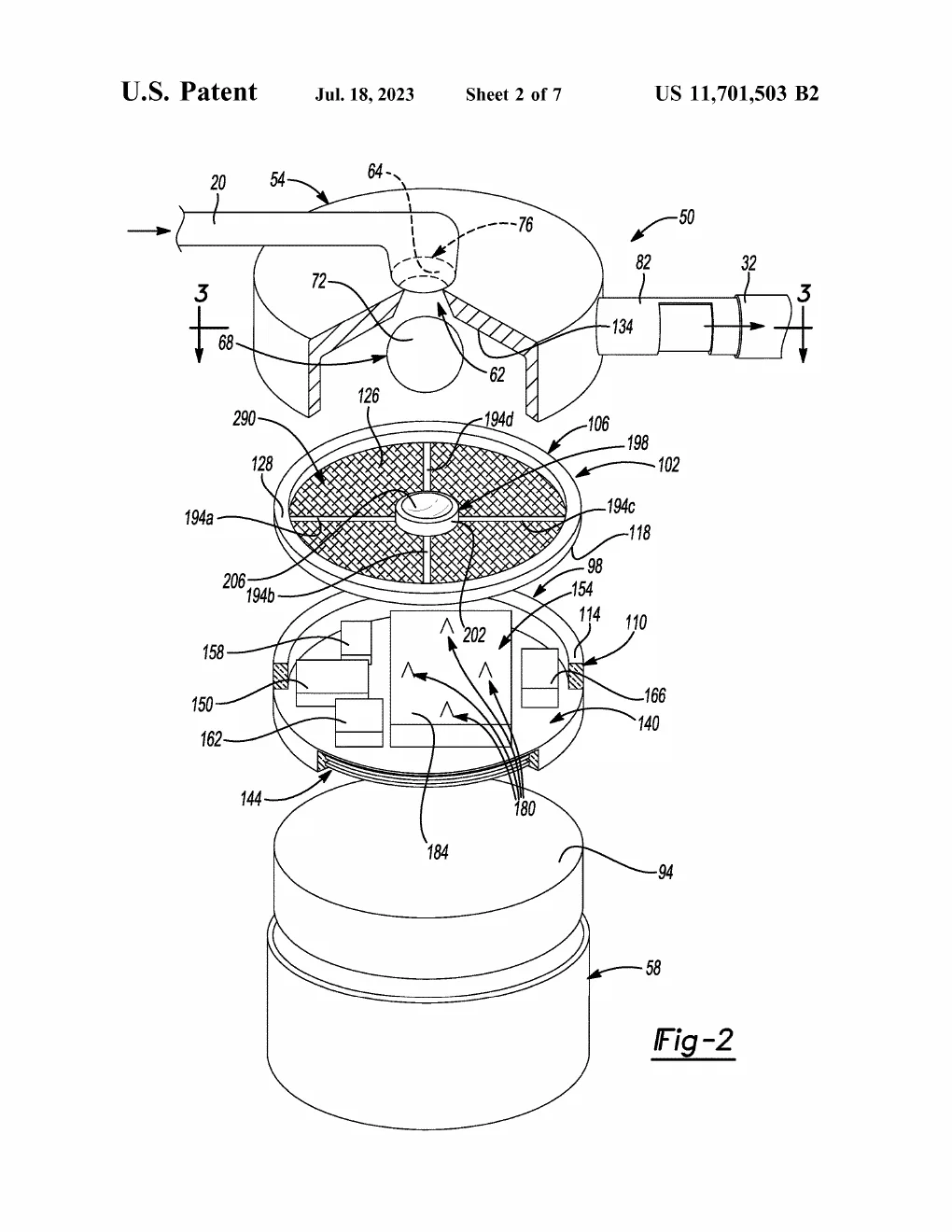
An exploded perspective view of the valve assembly pulled apart into its stack: the inlet connector and domed housing with its ball-and-cone valve seat on top, the cross-hatched flexible membrane disc beneath it, the plate carrying the MEMS actuators and electronics below that, and the fluid reservoir base at the bottom.
United States Patent and Trademark Office · public domainThe choices were not stubbornness; the rulebook rewards them. Where “hermetic” is a measured number and every change to a Class III seal is a change to the safety case, a laser weld you can cross-section and leak-test beats a cheaper adhesive with a vaguer aging story. The regulations select for techniques that can be characterized to death — precisely the clean, individually testable joins he builds. When the standard leak test physically broke down at small scale, he answered with US7902851B2: test structures built into the bond. The standard couldn’t follow implants down in scale, so he built the test into the seal.
Given an easy road and a hard one, he kept choosing the hard one — active over passive, closed-loop over fixed, seal-it-full over seal-it-empty — because the hard road was more capable, and because he had spent his career building the tools that made it survivable. His packaging craft is the down payment that lets him afford the ambitious sensor.
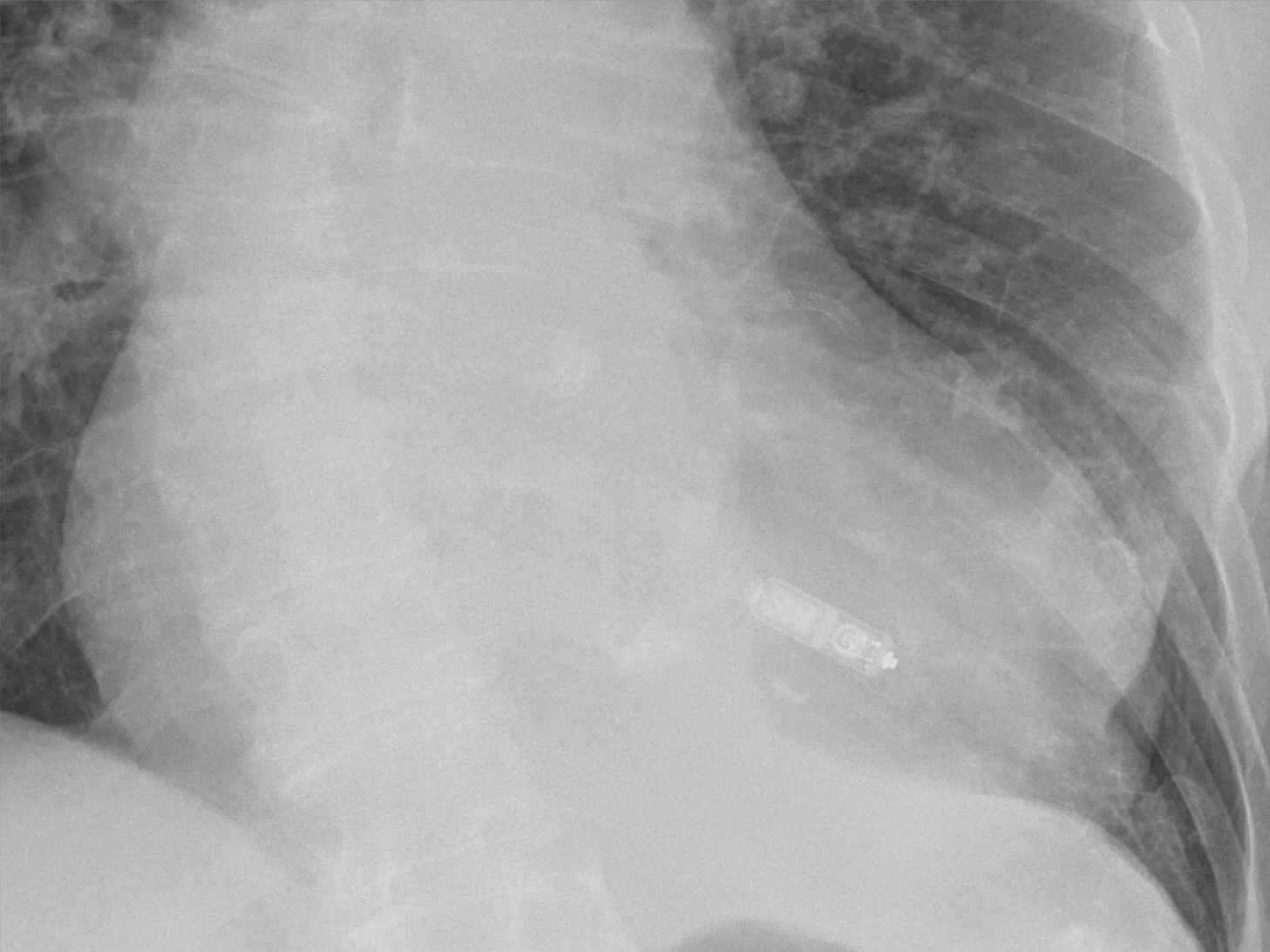
Where the road led: a two-gram capsule glowing in a ninety-five-year-old chest — no wires, no pocket, no seam the body can find.
Hellerhoff, CC BY-SA 4.0, via Wikimedia CommonsThe Frontier Turns Toward Him
Then the industry’s center of gravity moved again — from stimulating the body to reading it. Continuous glucose monitoring, barely a commercial category in 2010, became med-tech’s growth engine, and a chronic sensor’s accuracy turned out to be set less by the transducer than by the tiny hermetic room built around it. The frontier had wandered onto Ruben’s home ground, and it converged on his materials from three directions at once.
Joining: in 2018 the glass giant Schott acquired Primoceler, pioneer of heat-free laser glass micro-bonding aimed explicitly at implants — the same fire-through-the-transparent-layer physics his corpus had practiced for a decade. Ruben’s own answer is co-assigned with the other glass giant: the Corning–Medtronic kinetically limited nano-scale diffusion bond, US10124559B2 — sapphire laser-bonded to titanium in a joint under a thousand nanometers thick, its named applications reaching vacuum windows, photonics, and spacecraft.

A labeled electron-microscope cross-section (200 nm scale bar) with plain-English callouts: undisturbed bulk titanium on the left, undisturbed single-crystal sapphire on the right, and the nanometer-scale interfacial bond joint measured between dashed lines in the middle.
United States Patent and Trademark Office · public domainPower: the microwatt-for-decades problem revived Medtronic’s own plutonium-pacemaker heritage by the modern betavoltaic route — and while startups made the 2024 news cycle, US10096393B2 and US11881325B2 had claimed a 3D-collector converter across tritium, nickel-63, and other beta fuels with priority back in 2014. Sensing itself: the pending stacked-analyte line fabricates mutually incompatible electrodes — glucose, ketones, potassium, creatinine — separately and stacks them: a metabolic panel as an implant.
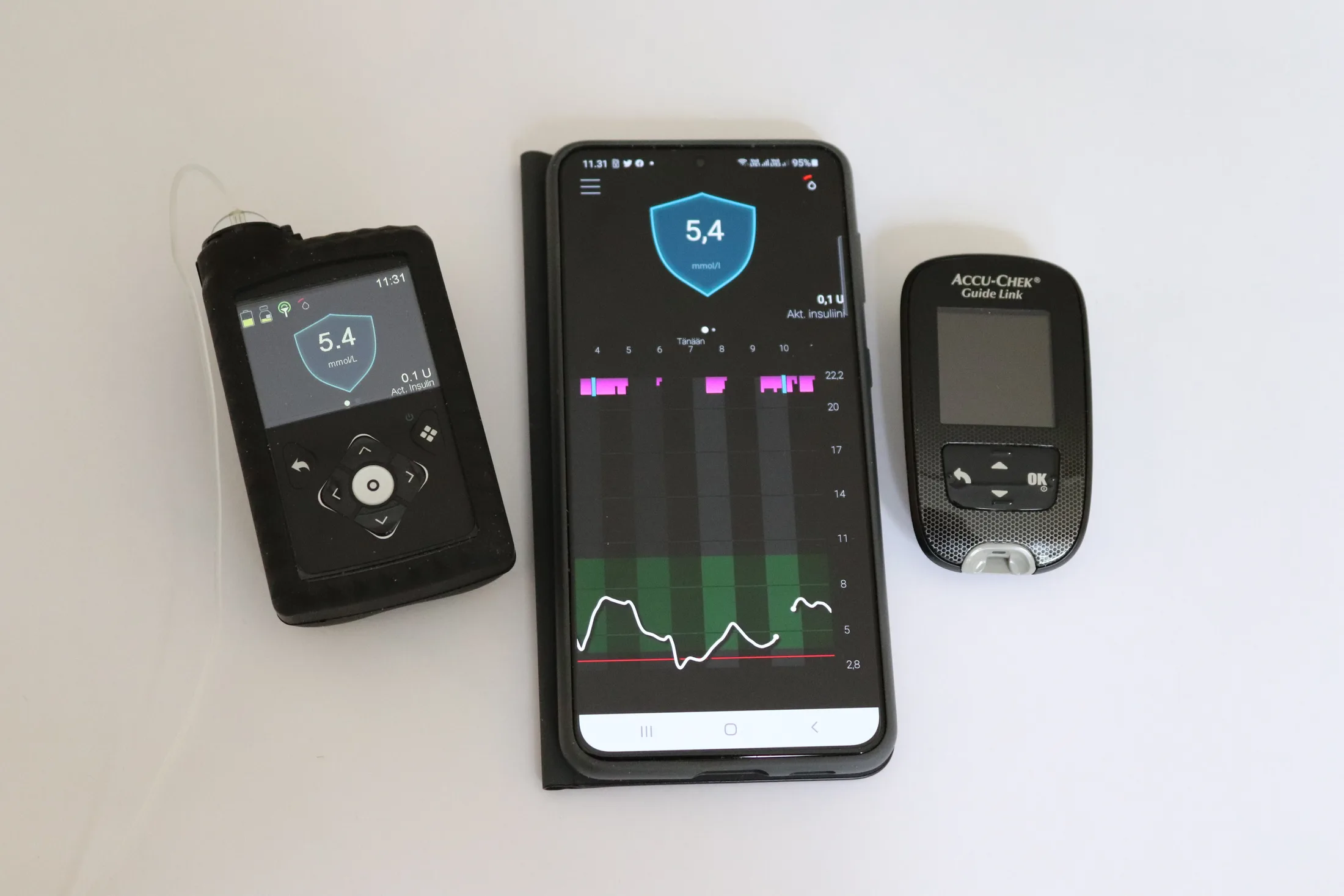
Medtronic’s MiniMed 780G closed-loop insulin pump — the sensing-and-dosing frontier whose reliability rests on the packaging craft this corpus spent three decades refining.
MailariX, CC BY-SA 4.0, via Wikimedia CommonsThe newest grant closes the loop. US12610487B2, granted April 2026, seals a device on a transparent substrate — for laser bonding through it — to a power-source housing, with a pressure-only interconnect: capsule, seal, optic, interconnect in one geometry, reached by removing the solder joint a chronic fluid-immersed sensor would eventually lose. Reading a body from inside it means weighing a feather in an earthquake; the winner is whoever builds the quietest, smallest, longest-lived sealed room around the sensor. That room is what he had been building all along.
The corpus does not wander; it deepens one conviction across three decades — and when the world finally needed boxes that could listen, his were already the quietest in the room.
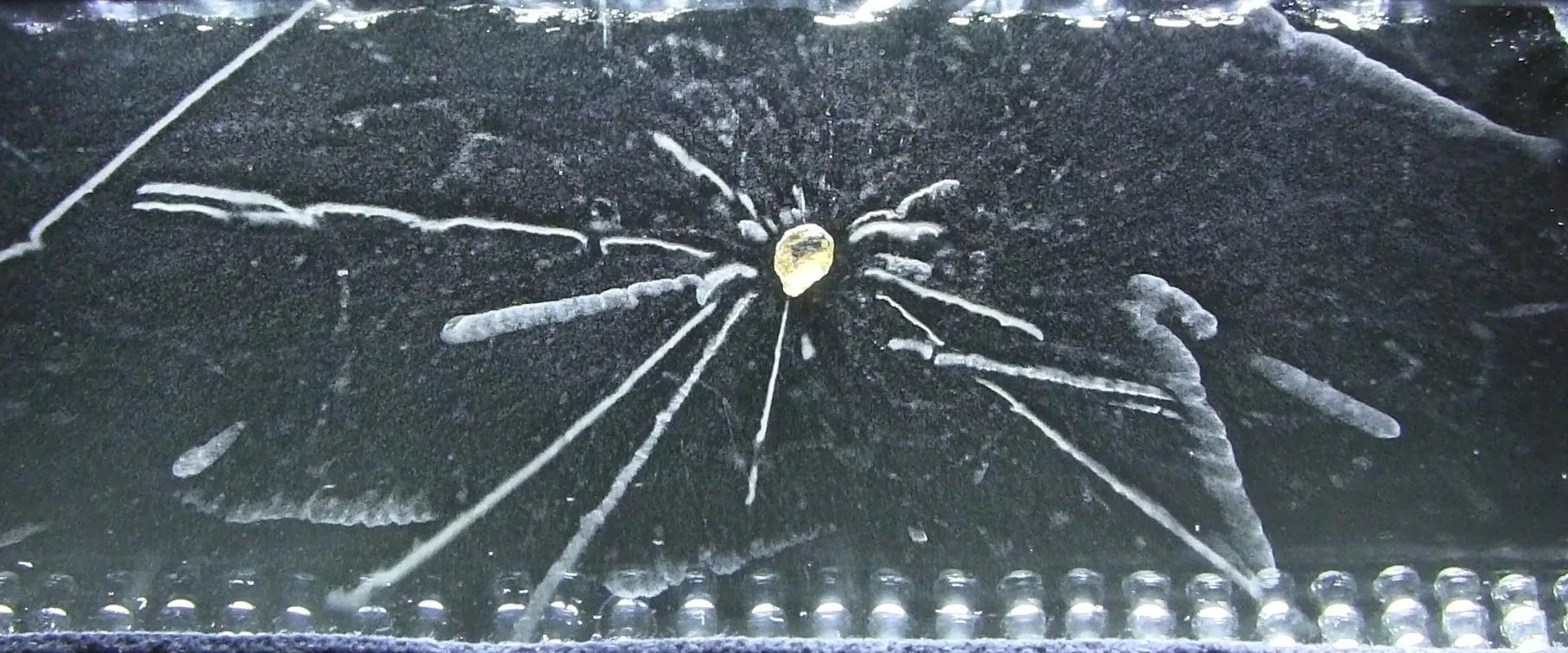
Most of this work is invisible by design. You only see it when someone builds the room where it can be seen.
Cloudylabs, CC BY-SA 3.0, via Wikimedia CommonsSix Studies
Each study follows one line of work from first filing to latest grant — the original drawing sheets set as plates, real photographs in the dark rooms, the physics drawn as working instruments, and every claim tiered to its source.
1993: The First Housing
The 1993 filing where every later theme is already present: the pacemaker’s body, redesigned so the parts locate themselves.
Open the study → Implantable Sensors · 1997-2001The Accelerometer Line: teaching the pacemaker to feel motion
The beam-stop that let a fragile piezo cantilever feel every footstep — and survive every fall. His most-cited work.
Open the study → Laser Materials Processing · 2000-2025The Laser Craft: light as a precision tool
Twenty-five years of light as a joining tool, ending in a sapphire-to-titanium bond measured in nanometers.
Open the study → Hermetic Packaging & Feedthroughs · 2014-2024The Feedthrough Line: wiring through an unbroken wall
Wiring signals through an unbroken wall — sealing a package already full of electronics and a live battery.
Open the study → Power Sources · 2015-2024The Nuclear Line: reviving the atomic heartbeat
Reviving Medtronic’s atomic heartbeat: a 3D betavoltaic collector claimed a decade before the microbattery news cycle.
Open the study → Flow Control & Surgical Navigation · 2020-2024The Valve: engineering mercy for hydrocephalus
A MEMS closed-loop valve for hydrocephalus — the heaviest human stakes in the corpus.
Open the study →Or open the complete record — all fifty-six grants, 1996–2026, arranged by the six lines of work.