Descent V · Power Sources · 2015-2024
The Nuclear Line: reviving the atomic heartbeat
At the bottom of the descent the fuel is time itself. A device that must run for a century sealed in a body cannot rely on chemistry — its discharge curve would be fixed by corrosion, not choice. Radioactive decay is the one power source whose service life is set by nuclear physics. The catch is geometry: how do you catch a rain that stops in a few microns of its own fuel?
- span2015-2024
- grants5
- lineBatteries that outlive their patients' need
US 10,096,393US 10,811,157US 11,881,325US 10,818,811US 11,189,390
Viewport · cloud chamber · decay, live
Radioactive decay made visible — particle tracks condensing out of supersaturated vapor. Not a metaphor: a rain you can photograph, and, folded cleverly enough around a semiconductor, a battery with a hundred-year half-life. Wilson chamber by Bilovitskiy, CC BY 4.0, via Wikimedia Commons.The historical arcT2 · external source
Medtronic has been here before. The first nuclear-powered pacemaker was implanted in 1970 (Doyle, "Rise and Fall of the Nuclear Pacemaker"), and in the early 1970s Medtronic teamed with the French company Alcatel on a plutonium-238-powered pacemaker whose decay heat drove a thermoelectric stack (Medical Design & Outsourcing). Hundreds were implanted (a Newark hospital alone tracked 155 units; one French series counted 325 patients — Doyle), and the longevity was astonishing: one 1973 recipient's device was still pacing 34 years later, where a chemical battery would have demanded repeated replacement surgeries (ORAU Museum of Radiation, accessed 2026-07-22; details re-attributed to their specific sources after adversarial QA). The approach faded — regulation, plutonium logistics, and the lithium-iodine battery won — but the dream (a power source that outlives the patient's need) never died.
Set-piece · betavoltaics · kb/physics
The Sponge Ni-63 sheds soft beta electrons — too gentle to damage a lattice, energetic enough to spray electron–hole pairs into a junction. But betas born deeper than a few microns never escape. The answer is to abandon flatness: a sponge-like 3-D collector, every atom of fuel within one beta’s range of a junction.The problemT1 · from the patentUS10096393B2
Modern betavoltaics skip the heat step: beta particles from a decaying isotope strike a semiconductor junction and generate electron-hole pairs directly, like a solar cell lit by radiation instead of sunlight. The catch — per the patent's description of what its 3D architecture improves (the background itself is a neutral recital of prior converters): flat junctions offer limited collection surface, and charge carriers can recombine before they're collected.
The principleT1 · from the patentUS10096393B2
Make the collector three-dimensional. Claim 1 builds the converter around a 3D current collector — nanorods, nanotubes, metal foam — coated with a charge-carrier separator (quantum dots are among the named embodiments) and a hole-conductor layer, with the radiation source placed so particles strike the separator. The nanostructure can "maximize a surface area … for any given volume" (verbatim, ellipsis ours), so far more of each particle's energy finds a junction before recombining. Named fuel candidates run from tritium to Ni-63 to Sr-90. A sibling line (US10818811) takes a different path: isotope → phosphor light → photovoltaic — a glow-in-the-dark battery, hermetically sealed by the same packaging craft as everything else in the corpus.
Plain-English registerT3 · interpretationconfidence: high
A flat solar panel wastes a floodlight shining from every direction. Crumple the panel into a sponge and hang the light inside it, and almost every ray lands on a working surface. That's the 3D collector — a sponge for radiation.
Specimen tray · Pu-238 · self-heating
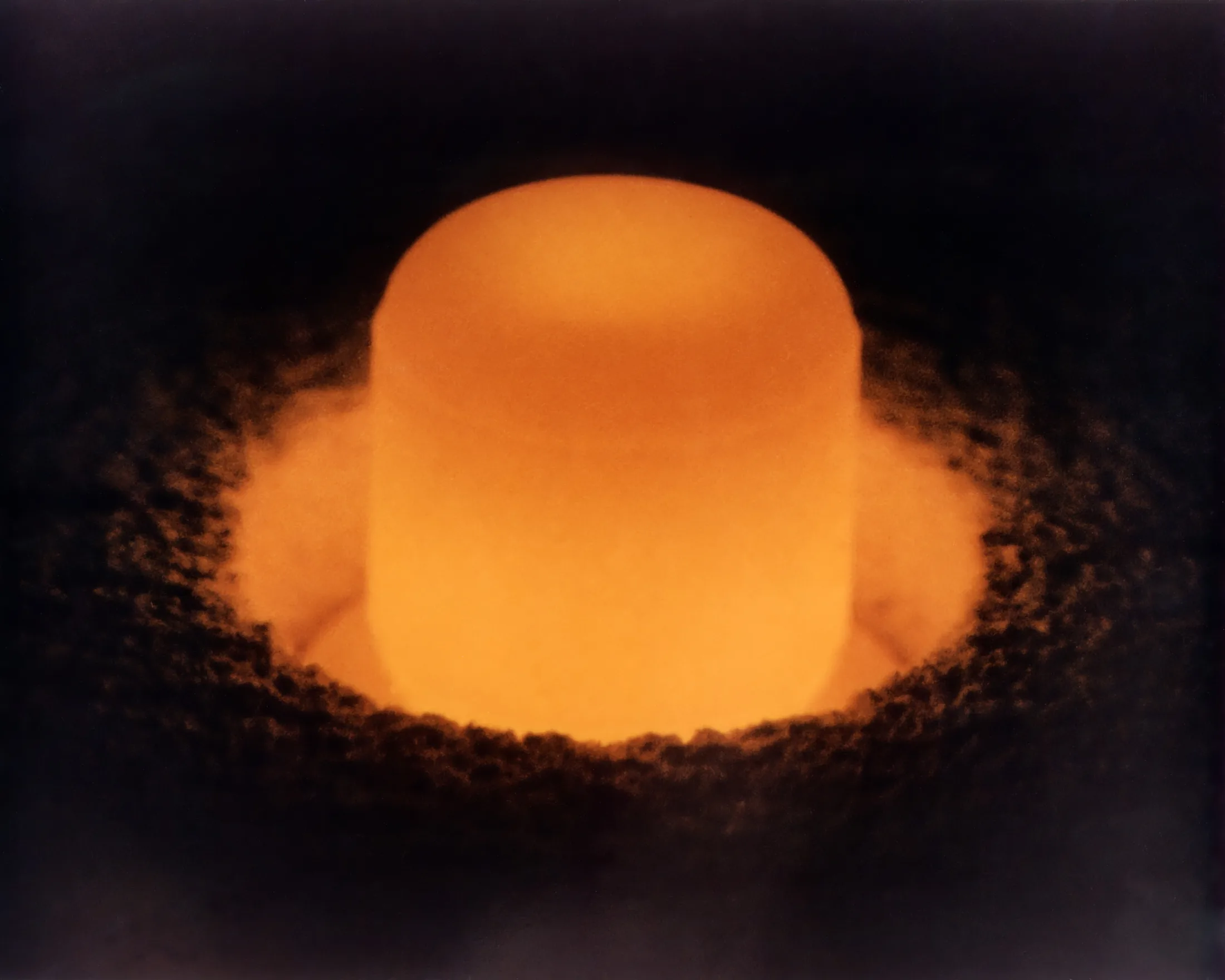
Matter glowing by its own decay. The 1970s pacemakers ran on exactly this warmth; one 1973 recipient’s device was still pacing thirty-four years later. Plutonium-238 oxide pellet glowing under its own decay heat — U.S. Department of Energy, public domain, via Wikimedia Commons.Honest statusT3 · interpretationconfidence: medium
Five grants (2018–2024) and sustained follow-on filings show real Medtronic investment, but no public source indicates a shipped nuclear-powered Medtronic product today — we don't claim one. What the record supports: this is forward-looking R&D reconnecting the company to its own atomic history, aimed at the same prize the 1970 device chased — implants that never need a battery change.
Set-piece note (for Presentation)T3 · interpretation
Split-screen: 1970 archive-styled Pu-238 pacemaker (thermal glow) fades into the modern converter — camera inside the nanostructure sponge, beta particles streaking in, each strike lighting a junction like rain on water. History → future in one dissolve. (Patent figures are public domain; period imagery needs sourcing/licensing care.)
Phosphor plates · the drawings, inverted into the dark
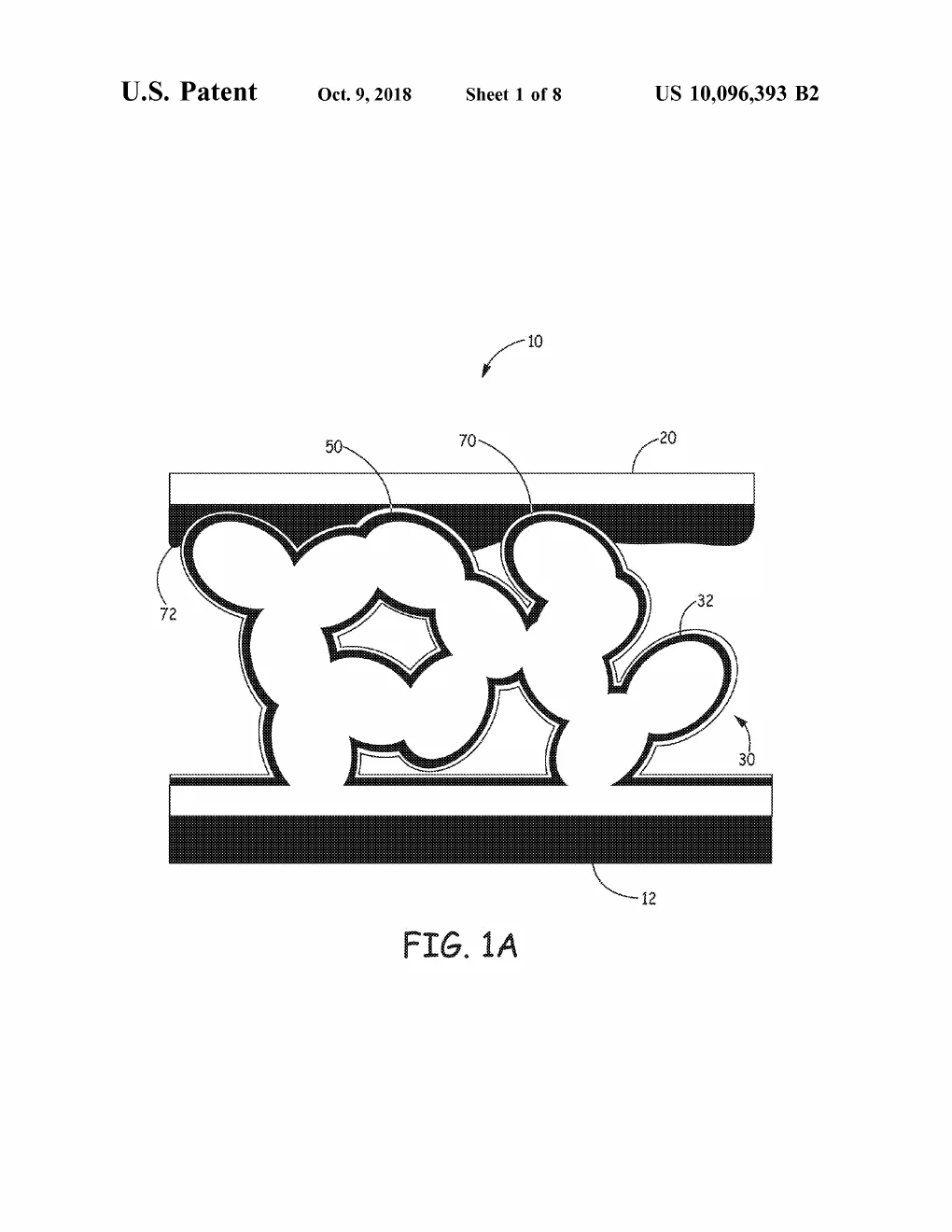
The plate · US 10,096,393 · FIG. 1A
A cross-section of the whole betavoltaic cell: a sponge-like tangle of interconnected 3D nanostructures, each lobe traced with thin coating layers, filling the gap between two flat electrode plates top and bottom. US patent drawing — public domain.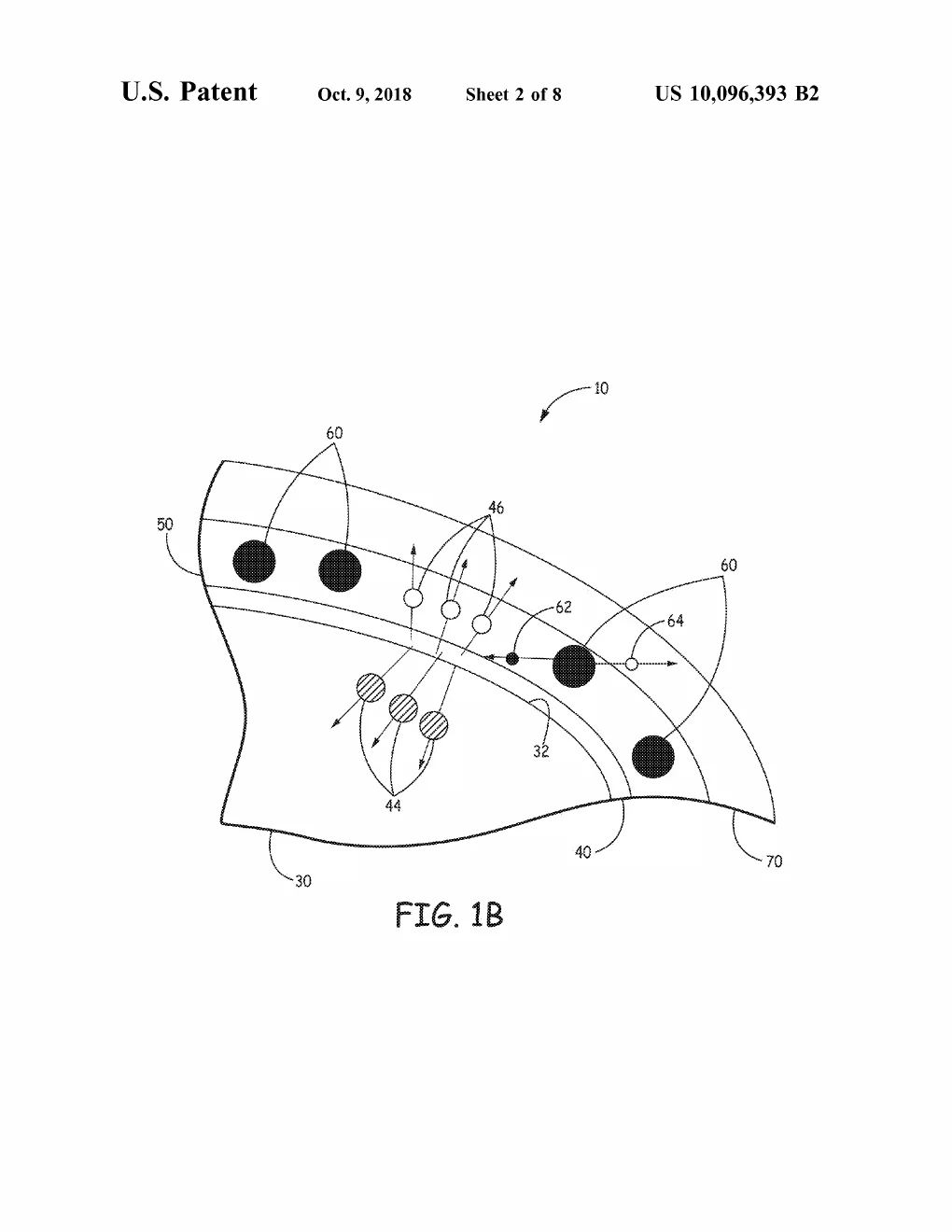
Plate II · US 10,096,393 · FIG. 1B
A magnified slice through one coated wall of the sponge, with quantum dots drawn as dark circles in the layer stack and arrows tracing beta particles striking in and freed electric charges being pulled apart across the layers. US patent drawing — public domain.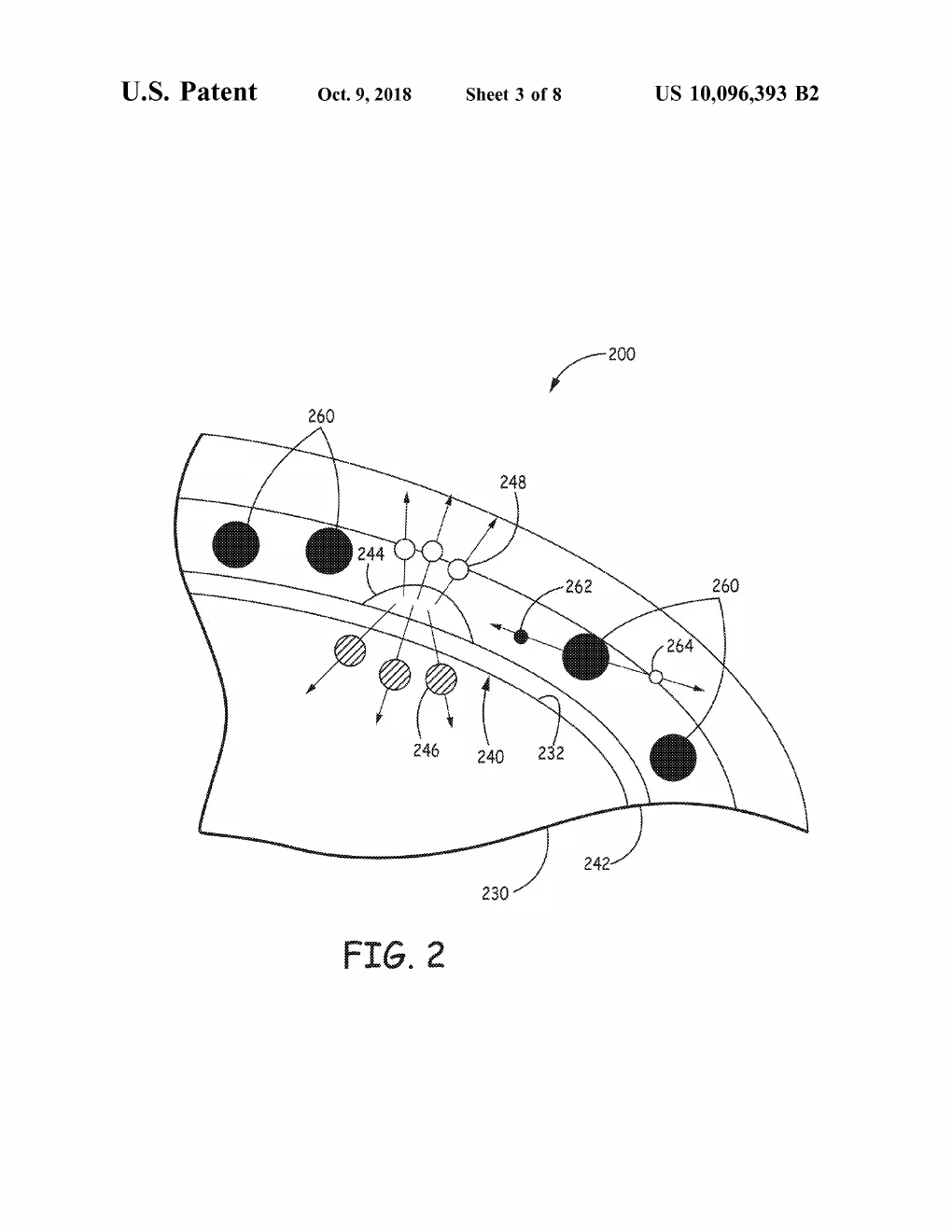
Plate III · US 10,096,393 · FIG. 2
A close-up cross-section of an alternate layer stack, again with quantum dots embedded in the coating and arrows showing radiation particles arriving and the resulting positive and negative charges separating toward opposite layers. US patent drawing — public domain.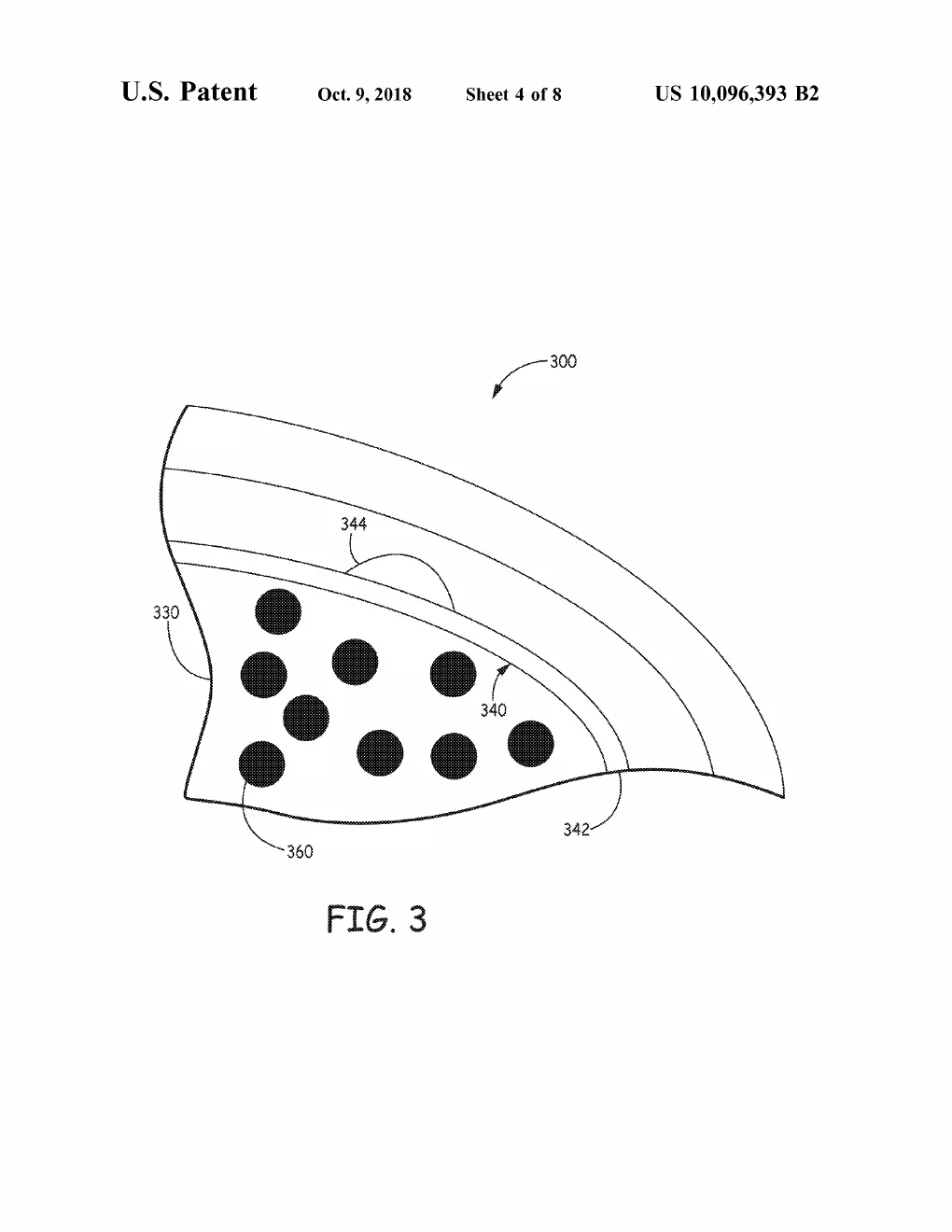
Plate IV · US 10,096,393 · FIG. 3
A cross-section of an embodiment where the radioactive fuel itself, drawn as a scatter of dark particles, is embedded inside the collector body beneath the coating layers instead of shining in from outside. US patent drawing — public domain.Impact · why this shaft matters
Five grants revive an atomic heartbeat the industry abandoned — this time skipping the heat and harvesting the electrons directly, in a collector shaped like a sponge. A trickle of current, with a century on its clock: the deepest wager in the corpus.