Observation chamber · David A. Ruben · Medtronic · 56 US patents · 1993–2026
Step inside the sealed machine.
This is a descent. Six levels, ten orders of magnitude — from a beating human heart, down through the device that keeps it in time, into the seam that seals it, across an interface tens of atoms thick, and finally inside the atom whose decay could power it for a century. At every level: one engineer’s patents, thirty-three years of them, holding the wall between electronics and the living body.
- medium0.9% saline
- temp37.0 °C
- mission≥ 10 years, no service calls
- failures allowed0
Level 1 · 10−1 m · the body
The client is a muscle that never rests.
Specimen 01 · human heart · live
Seventy beats a minute. A hundred thousand a day. Four hundred million over the ten-year life a pacemaker must promise. Everything in this archive answers to this rhythm. Heart animation by Rosamedinalo, CC BY-SA 3.0, via Wikimedia Commons.Begin with the problem statement no datasheet softens: the machine must live here. Warm salt water, chloride ions, dissolved oxygen, a body that moves and an immune system that objects — and inside the machine, circuits that tolerate essentially none of that water. The engineering one layer beneath every therapy is a promise: nothing leaks in, nothing leaks out, for a decade or more.
Level 2 · 10−2 m · the chest
Sixty years of descent, in one radiograph.
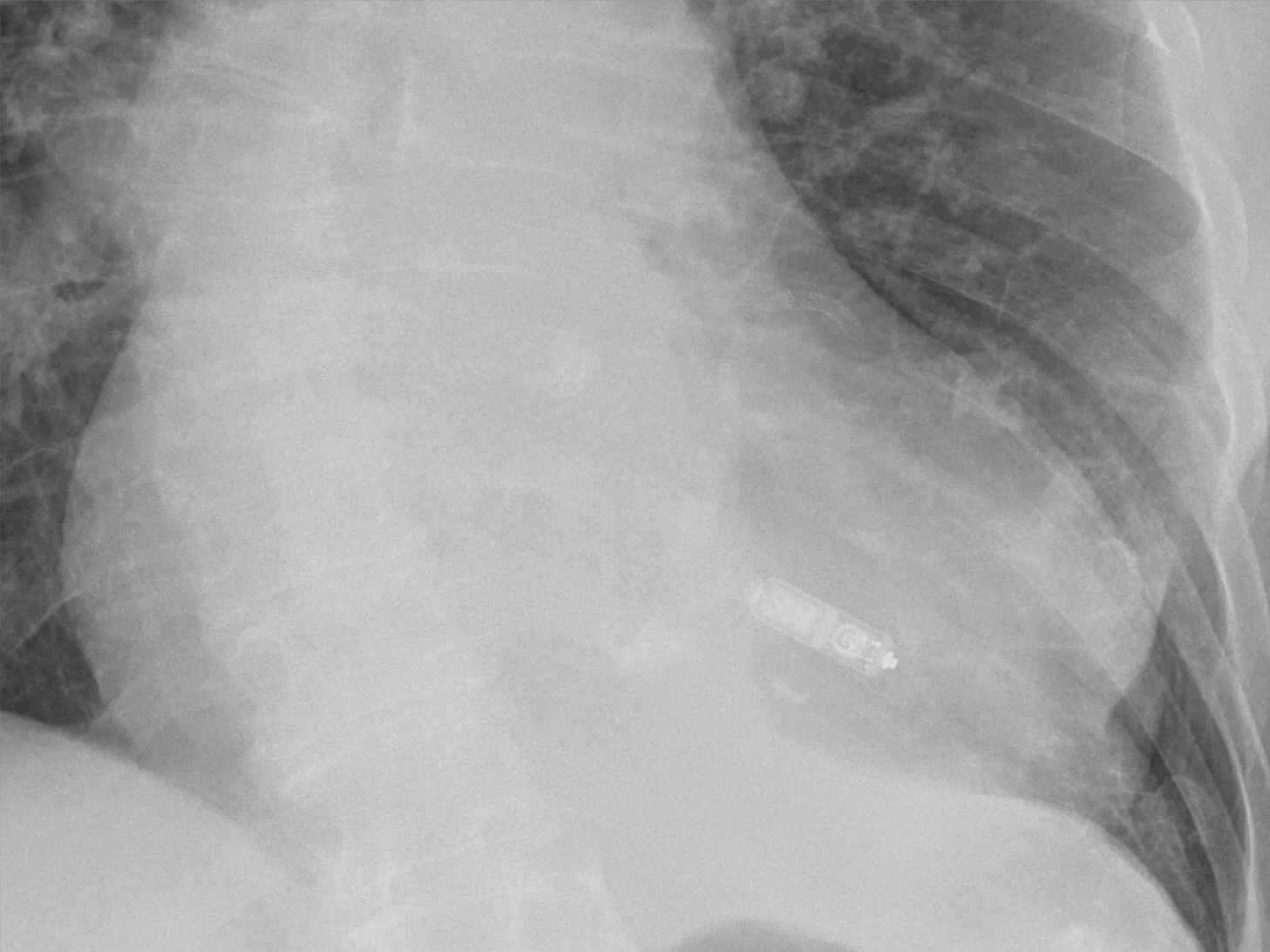
Radiograph · Micra leadless pacemaker · in situ
The bright grain inside the heart's shadow is a complete pacemaker — battery, circuits, sensors, hermetic housing — resting where the therapy is needed. In 1961 this machine was a box on a strap with dials you turned by hand. Chest X-ray with a Medtronic Micra leadless pacemaker in the heart — Hellerhoff, CC BY-SA 4.0, via Wikimedia Commons.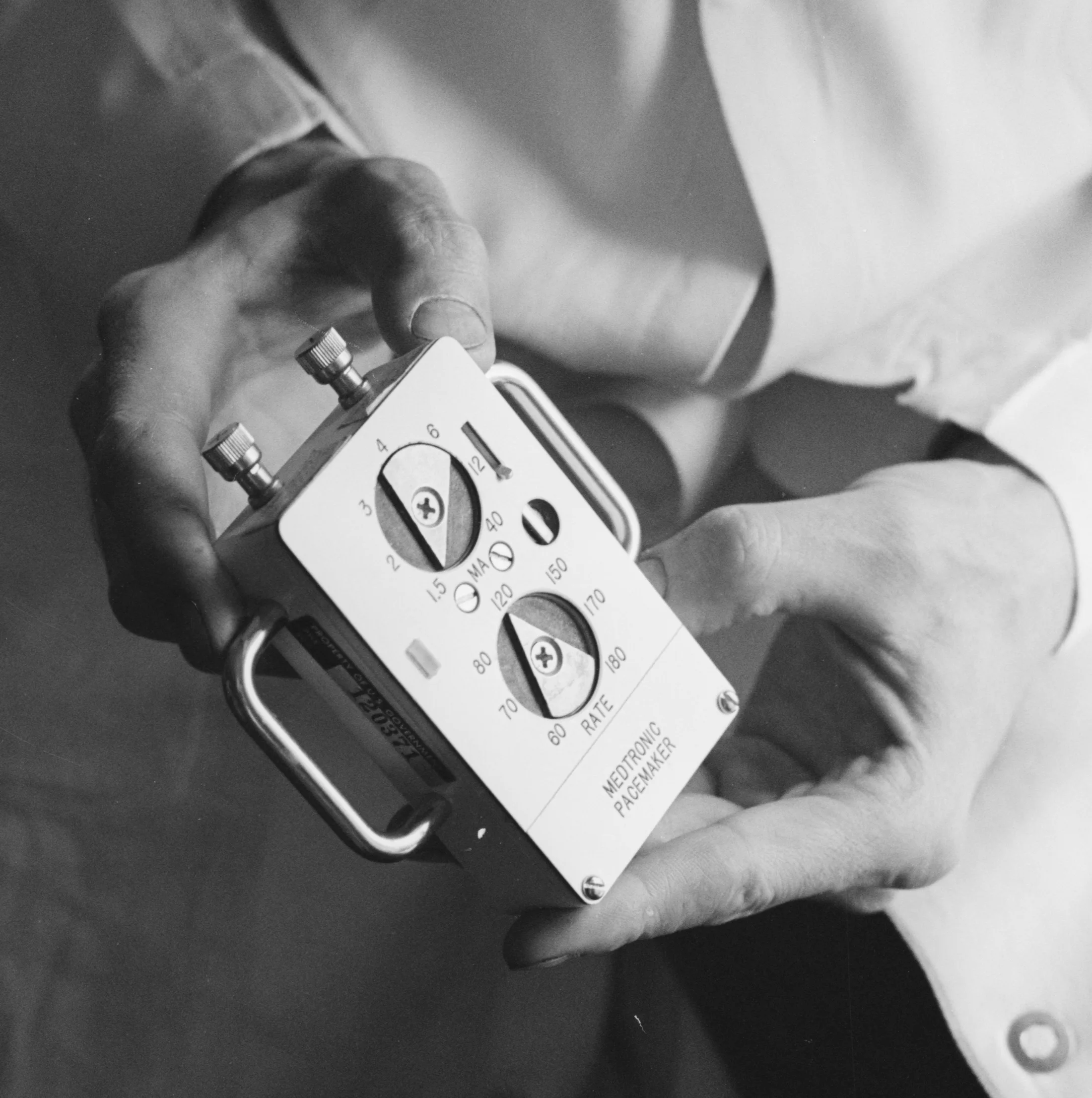
Era zero · 1961
Hands on a Medtronic external pacemaker — the machine still outside the body, still adjusted by touch. Hands holding a Medtronic external pacemaker, 1961 — Warren K. Leffler, U.S. News & World Report Magazine Photograph Collection, Library of Congress — public domain, via Wikimedia Commons.Between those two machines runs the story this chamber tells: fifty-six United States patents, filings unbroken from 1993 to 2025, almost none of them therapy. They are the packaging, joining, sensing, and power hardware — the disciplines that decided whether the box on the strap could ever become the grain in the X-ray.
Level 3 · 10−2 m · the device
A box designed to be closed exactly once.
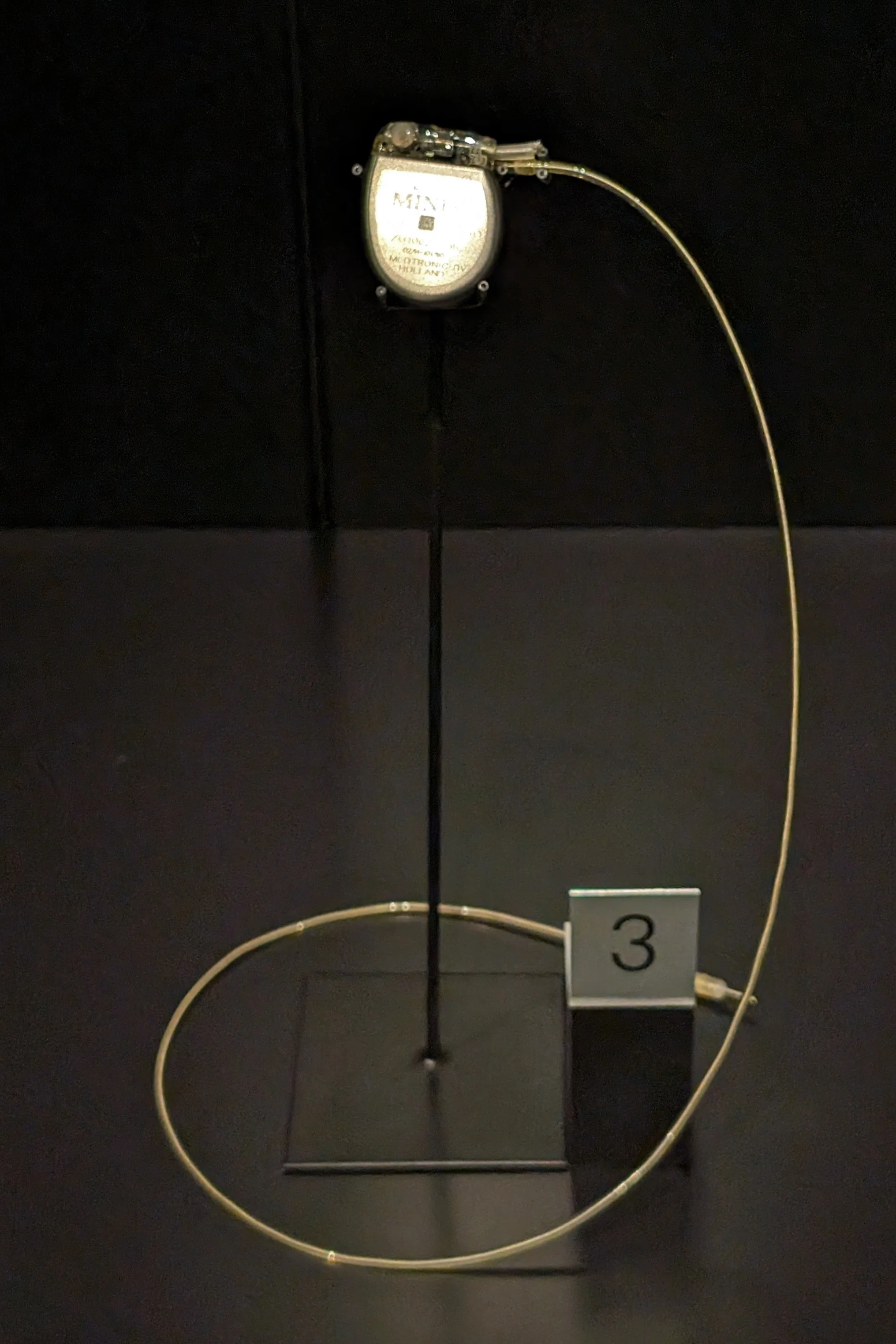
Artifact · Medtronic pacemaker · 1993
A pacemaker of 1993 — the very year of the first filing in this corpus — now kept under museum glass. Titanium can, welded rim, connector block: the anatomy his first patent redesigned from the inside. Medtronic Micro-Minix pacemaker (1993), Science Museum, London — The wub, CC BY-SA 4.0, via Wikimedia Commons.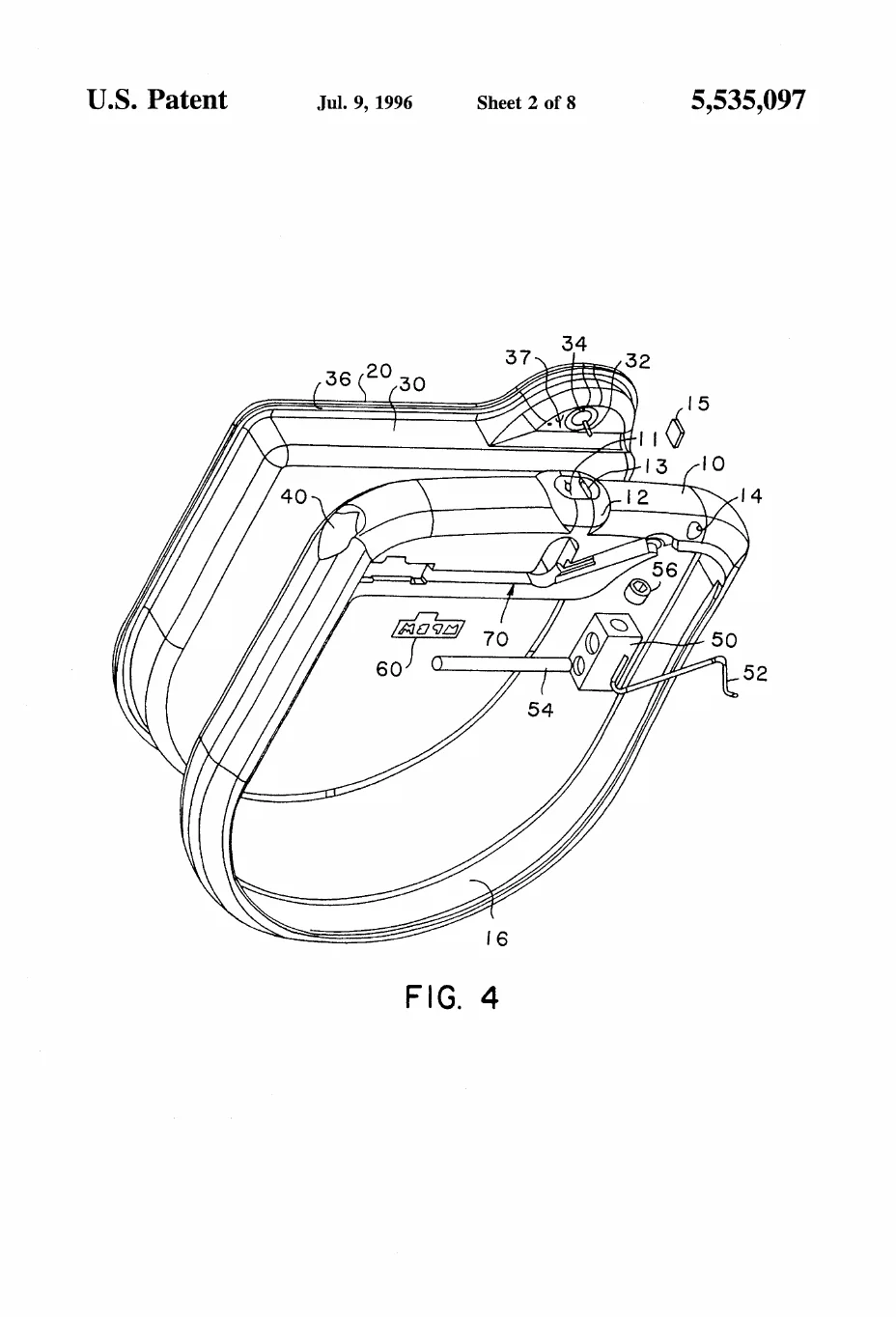
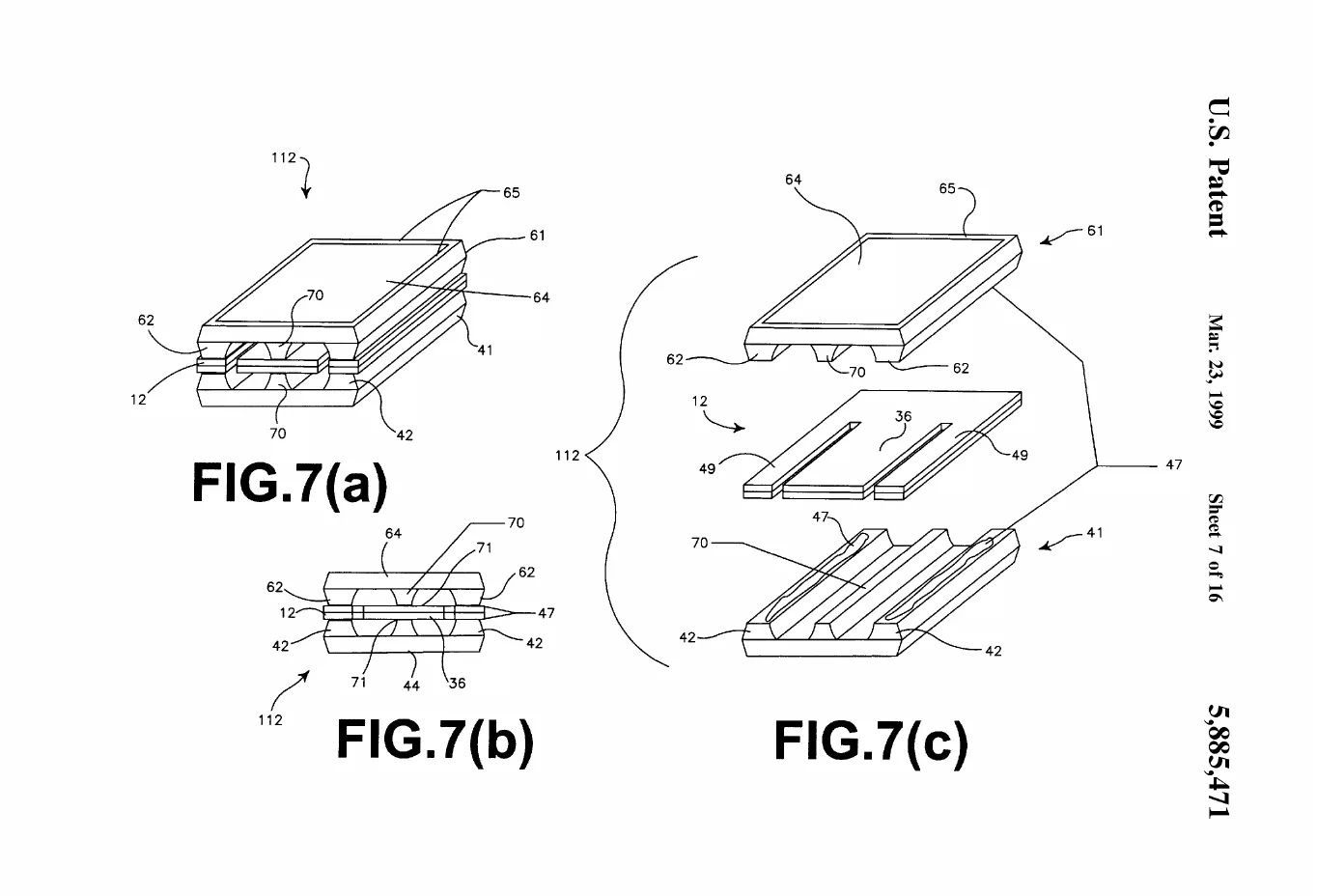
Phosphor plate · US 5,535,097 · FIG. 4
A perspective assembly view with the lid half pulled away from the main shell, exposing the connector hardware between them — the connector block, setscrew, spring contact, feedthrough pin, and sealing plug all floating in their positions like a freeze-frame of the device being put together. US patent drawing — public domain.Filed November 23, 1993, David A. Ruben first on the inventor list: the pacemaker’s body itself. The era’s standard was a “clam shell” — two halves butt-welded around the electronics, plastic cups holding each part, many steps, many chances for error. The patent’s answer: shape the enclosure’s interior so the parts locate themselves, bond with the chip industry’s wire bonds, then close the lid once — and make the closing perfect.
Level 4 · 10−4 m · the seam
Closing the lid is an act of light.
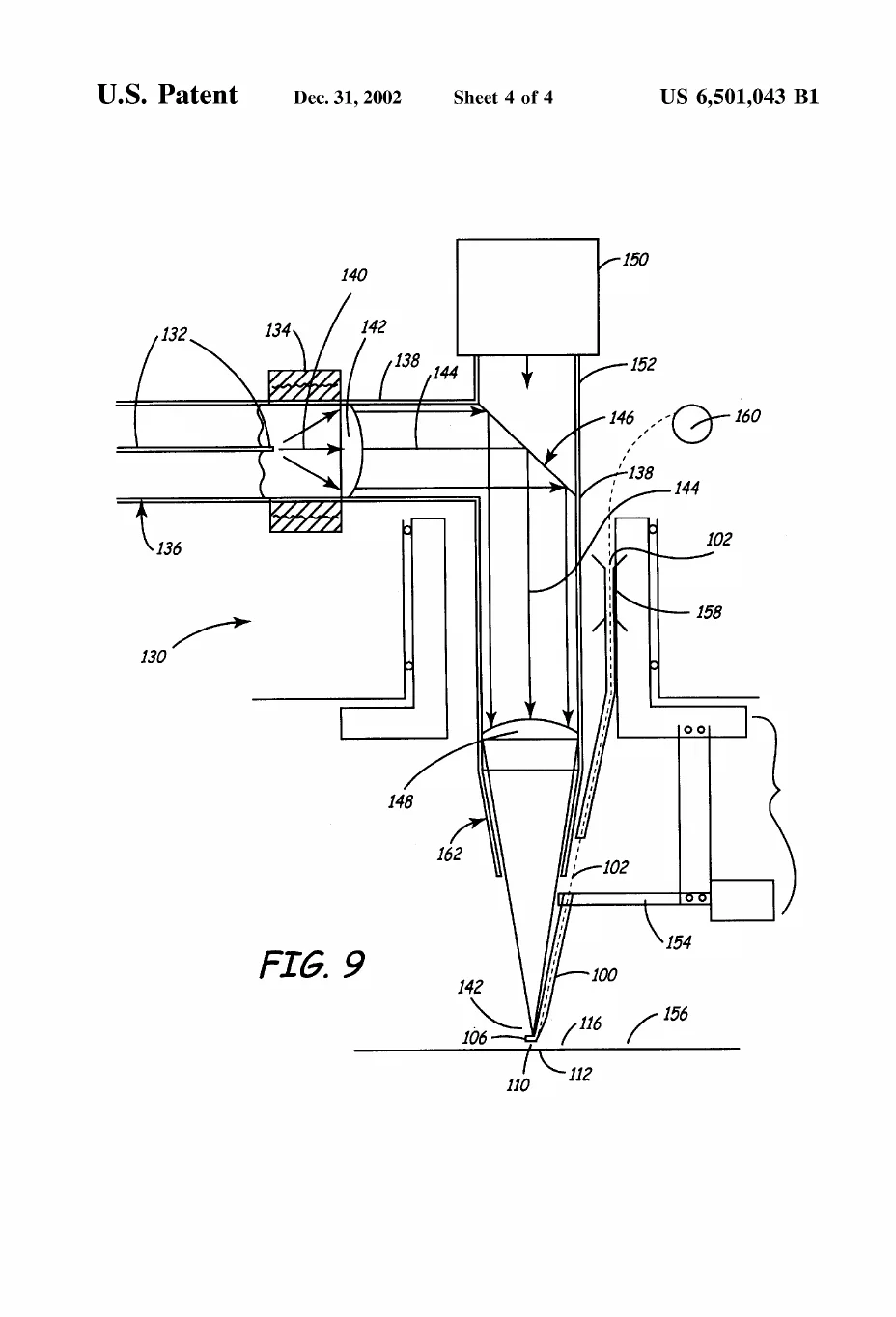
Viewport · laser welding · beam on
A laser walks a metal joint, sparks leaving on their own schedule. Eleven of the fifty-six patents are this craft brought down to the width of a human hair: pulsed light, each spot remelting half of the pulse before it, until the chain of small suns reads as one hermetic seam. Richard Hewitt, WMG University of Warwick, public domain, via Wikimedia Commons.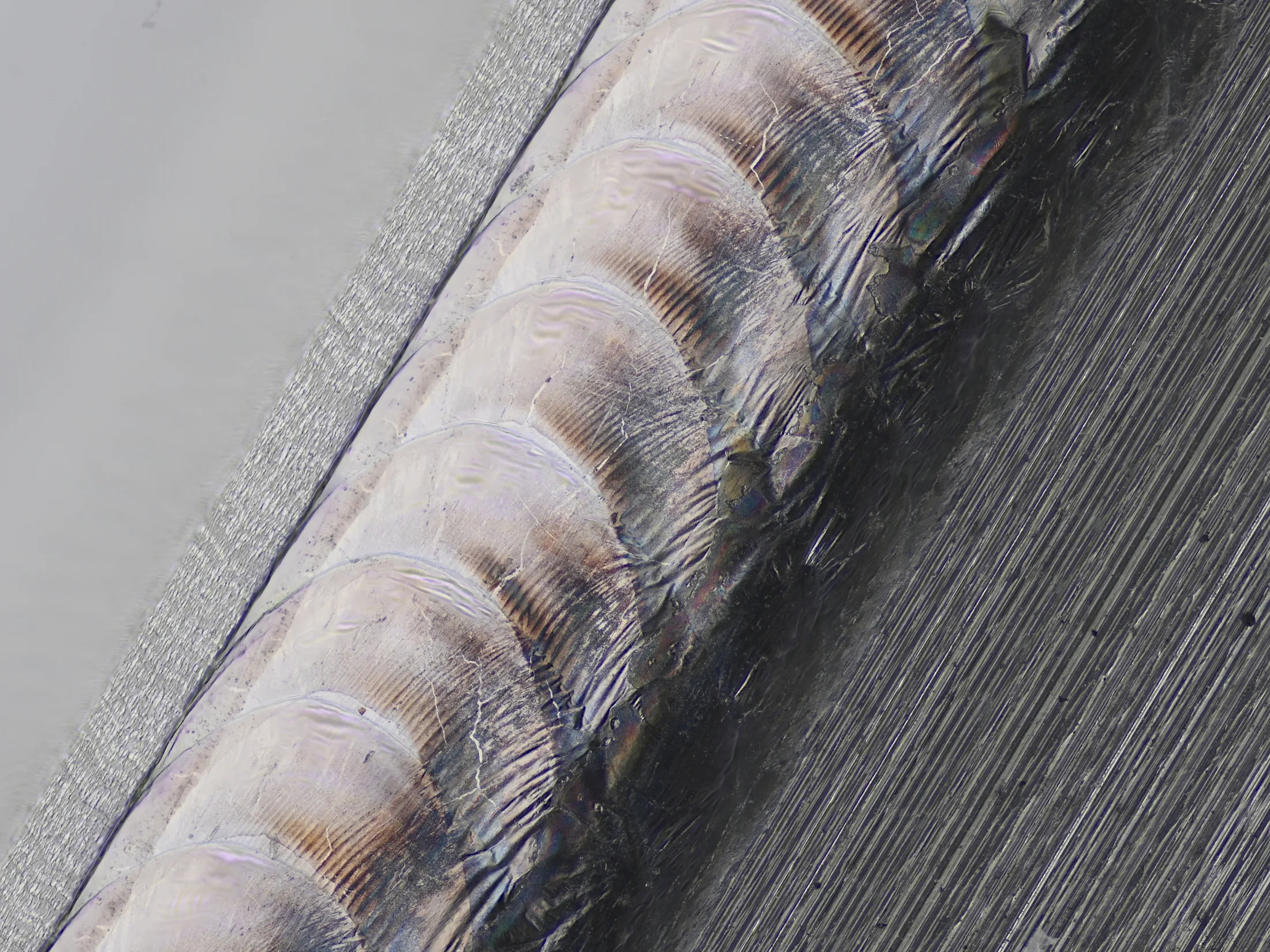
Macro · overlapping-pulse weld seam
The artifact, magnified: each crescent one pulse, each pulse remelting half its predecessor. The seam as penmanship. Macro of an overlapping pulsed laser weld seam hermetically sealing a helium-filled hard drive — Photo: Phiarc, via Wikimedia Commons, CC BY-SA 4.0.Level 5 · 10−8 m · the interface
Wiring through a wall that must never open.
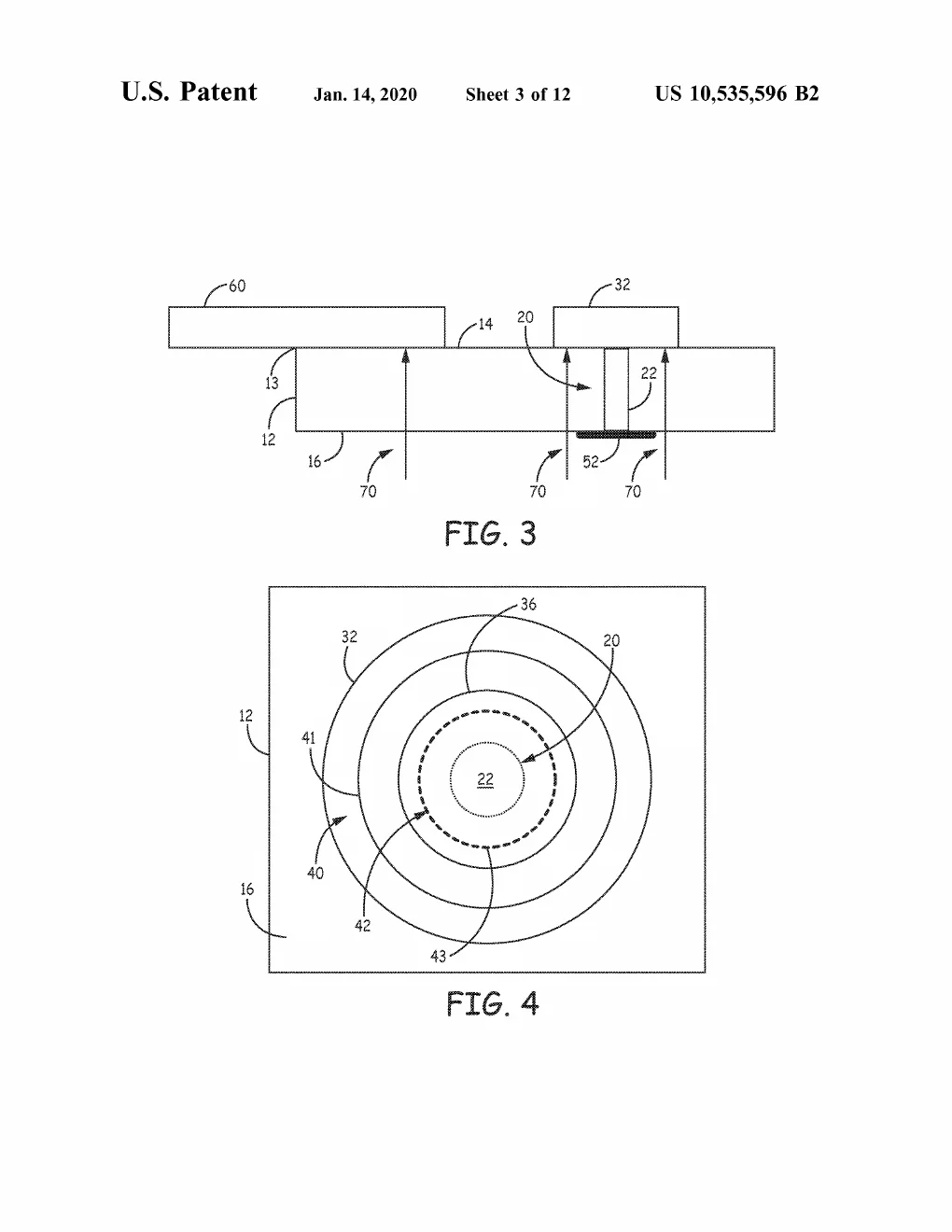
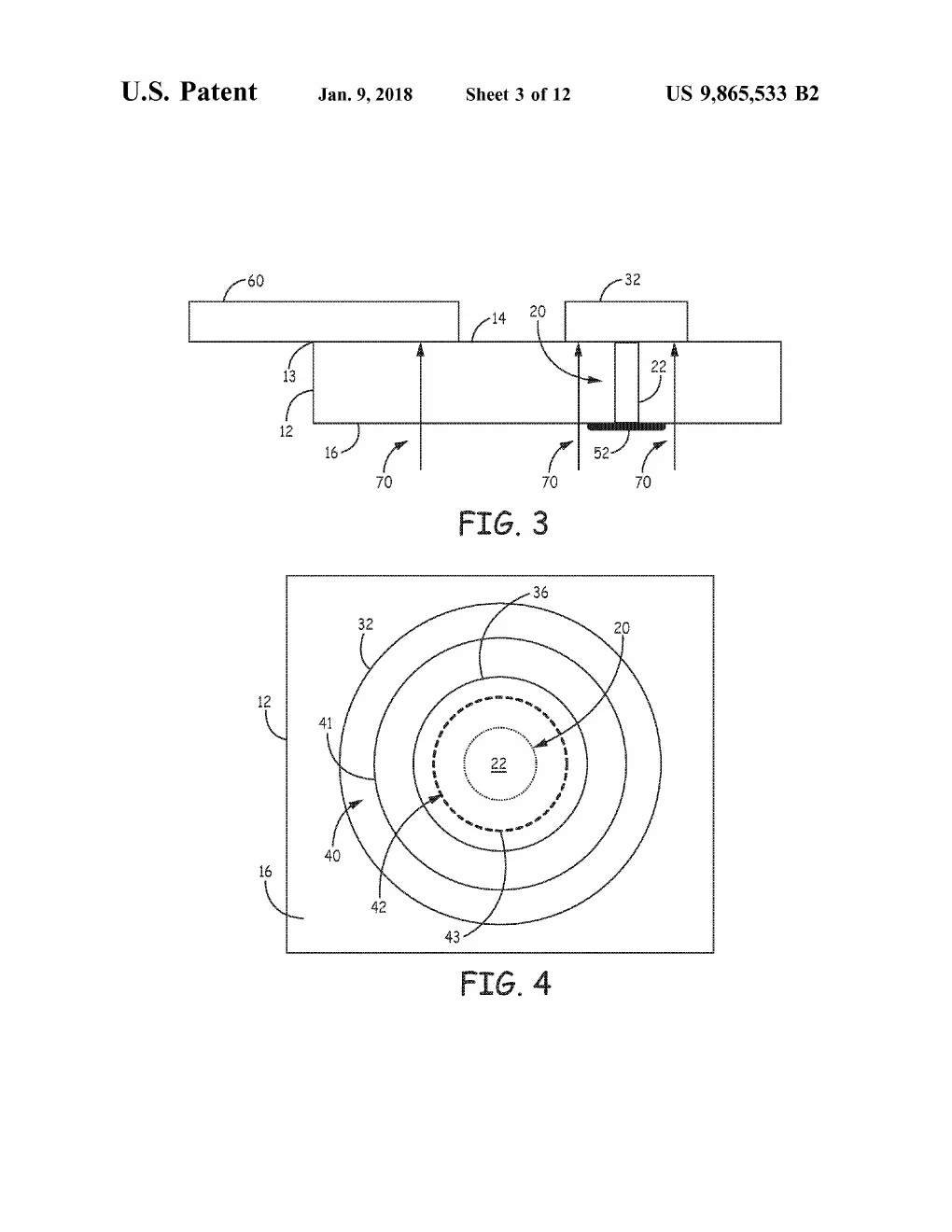
Phosphor plate · US 10,535,596 · FIG. 3, FIG. 4
A close-up cross-section with laser-beam arrows firing up through the transparent substrate to weld a contact over its via (3), paired with a bullseye plan view of the concentric ring-shaped bond zones surrounding the wire (4). US patent drawing — public domain.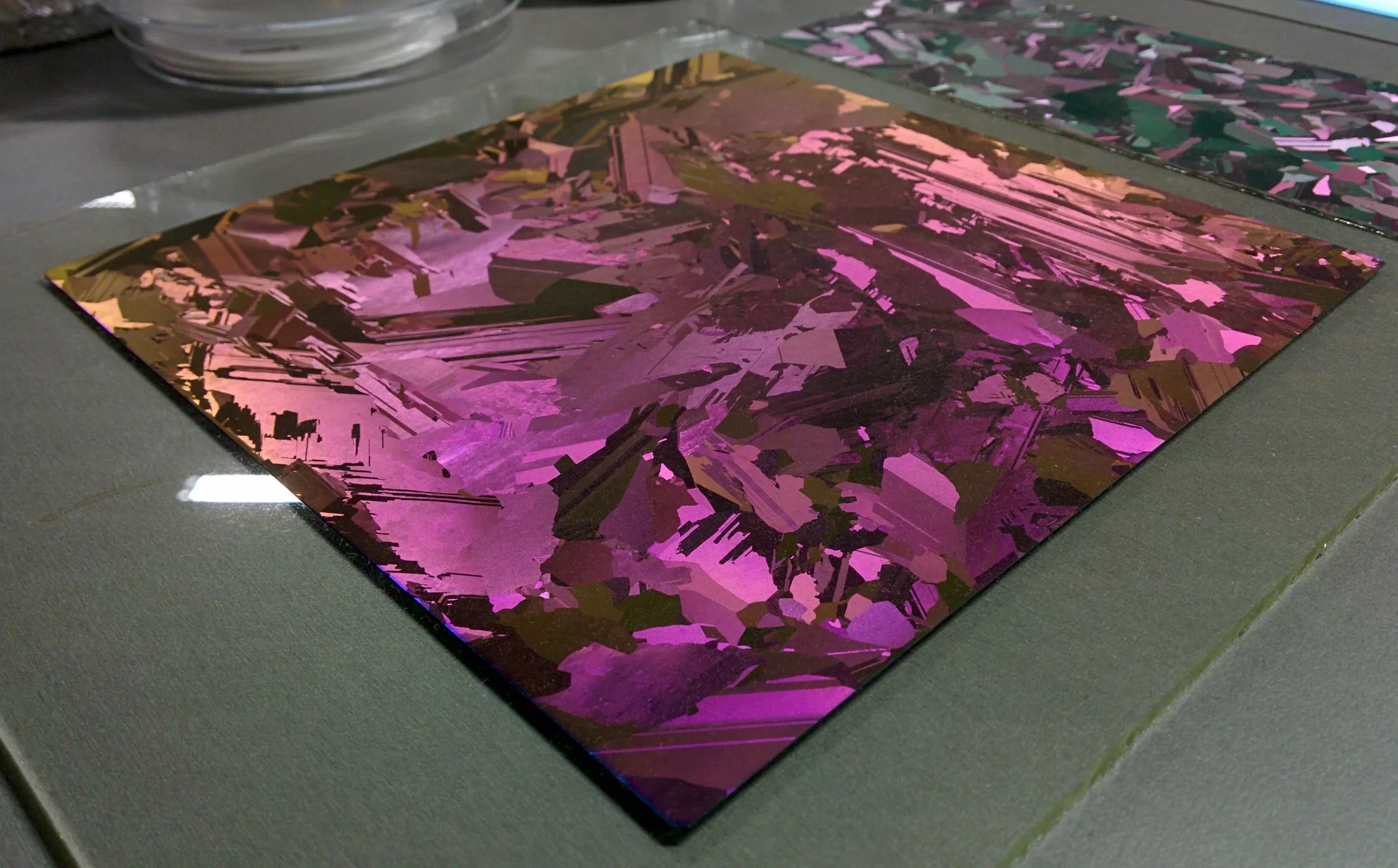
Wafer · film thickness ≈ 10−7 m
On this wafer a film one ten-thousandth of a millimeter thick repaints the whole surface. This is the scale where the feedthrough patents live — the iridescence this chamber borrows its light from. Multicrystalline silicon wafer with iridescent silicon-nitride thin film — Photo: Radiotrefoil, via Wikimedia Commons, CC BY-SA 4.0.Every implant faces the same paradox: seal the electronics away from the body absolutely, yet pass wires through the wall to reach it. That crossing — the feedthrough — is historically the hardest joint in the device. The old answers cooked whole assemblies: glass fused to pins, ceramic brazed in furnaces. This line’s answer runs the pulsed laser in a closed ring around each conductor’s doorway — a bullseye weld, cool everywhere but the joint, sealing a wall that never opens.
Level 6 · 10−10 m · the atom
At the bottom of the descent, the fuel is time itself.
Viewport · cloud chamber · decay events, live
Radioactive decay made visible: particle tracks condensing out of supersaturated vapor. Not a metaphor — a rain you can photograph, and, if you fold a semiconductor cleverly enough around it, a battery with a hundred-year half-life. Wilson chamber by Bilovitskiy, CC BY 4.0, via Wikimedia Commons.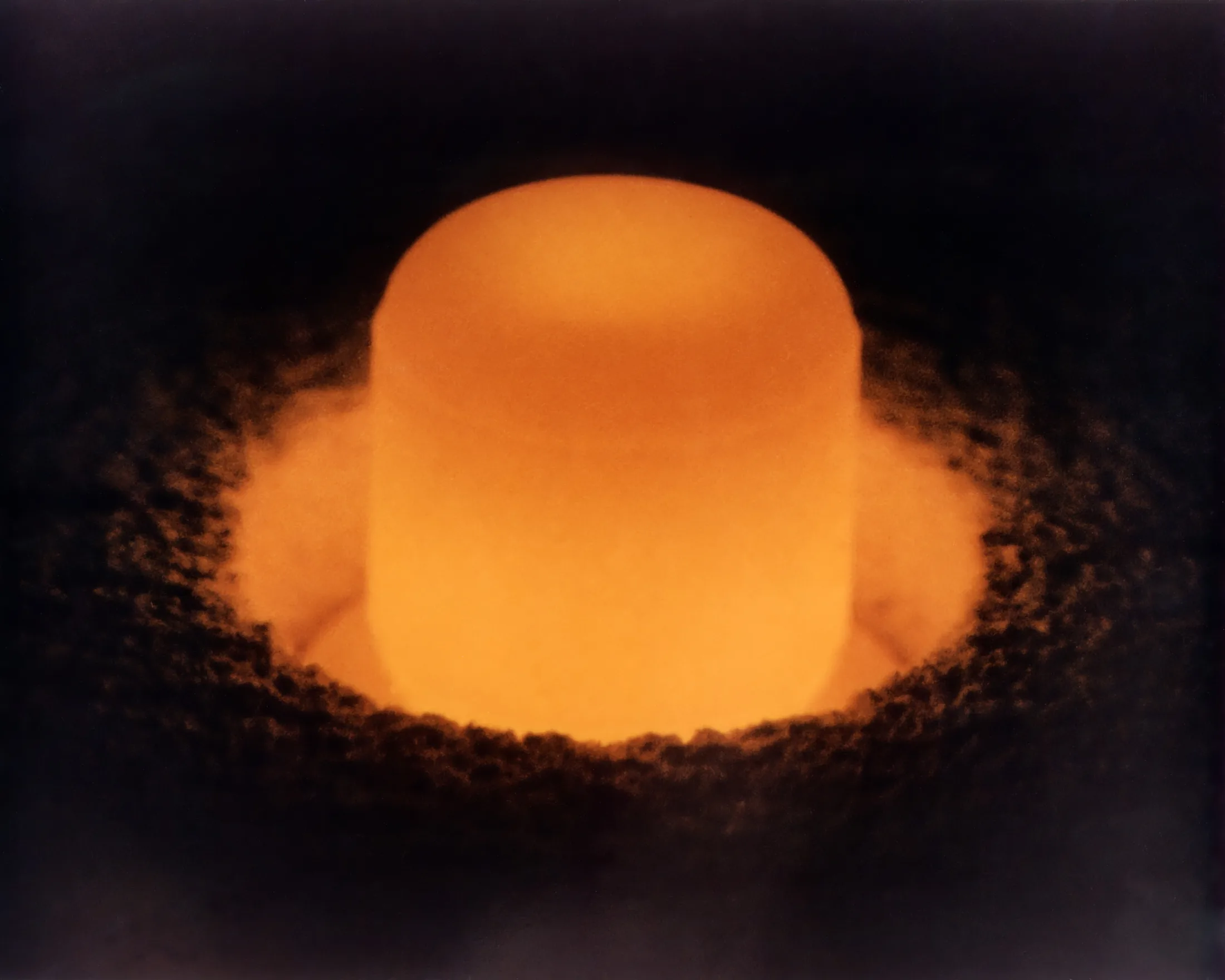
Specimen · Pu-238 · self-heating
Matter glowing by its own decay. The 1970s pacemakers ran on exactly this warmth; one 1973 recipient’s device was still pacing thirty-four years later. Plutonium-238 oxide pellet glowing under its own decay heat — U.S. Department of Energy, public domain, via Wikimedia Commons.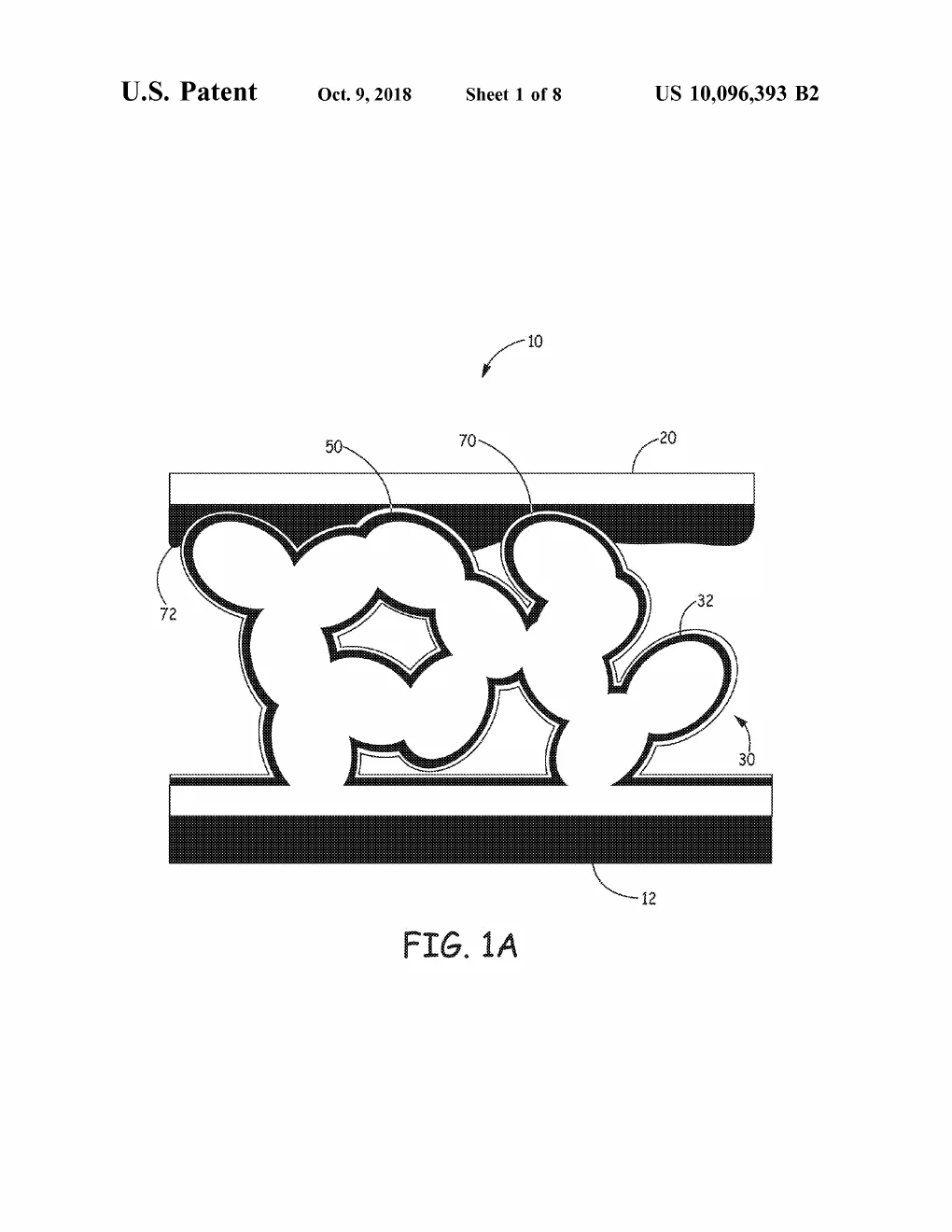
Phosphor plate · US 10,096,393 · FIG. 1A
A cross-section of the whole betavoltaic cell: a sponge-like tangle of interconnected 3D nanostructures, each lobe traced with thin coating layers, filling the gap between two flat electrode plates top and bottom. US patent drawing — public domain.Surfacing · six descents remain
Each line of the work is its own shaft. Pick one and drop.
All fifty-six grants, chronological, each opening to its drawing: enter the specimen index →