A private tribute cut
The Sealed
Machine
61 patents33 yearsone engineer
the patented work of David A. Ruben · Medtronic
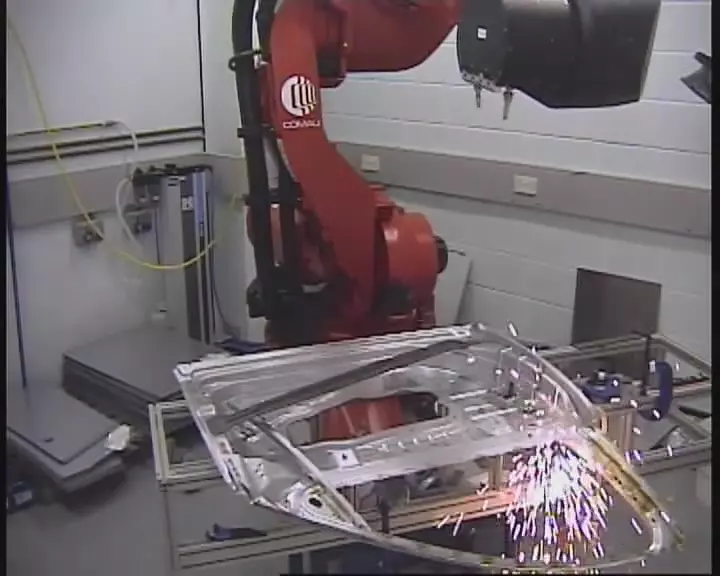
A robot laser welds a moving joint
He never worked at the surface where pacemakers win. He worked one layer down — in the packaging, joining, sensing and power that decide whether any therapy can survive a decade sealed inside a warm, salty, electrically live human body.
ACT I
The Problem
A dry box, ten years, in 37°C salt water.
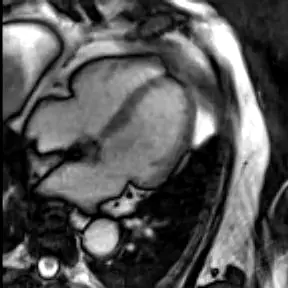
Real-time cardiac MRI — the machine watching the body
The problem statement
Everything inside must stay dry. Everything outside wants in.
An implantable pulse generator is a dry electronics box asked to survive ten to fifteen years soaked in warm saline carrying chloride, dissolved oxygen, and a relentless supply of water. The circuits inside tolerate essentially none of it. So “hermetic” here is not a marketing word — it is a physics problem with a hard floor.
Polymers always leak: water dissolves into their free volume and diffuses straight through a solid wall, no crack required. Only dense metal, glass, and fully-fired ceramic defeat both terms at once. That single fact sets the whole corpus in motion — and it is the reason a pacemaker’s body is a laser-welded titanium can, not a sealed plastic case.
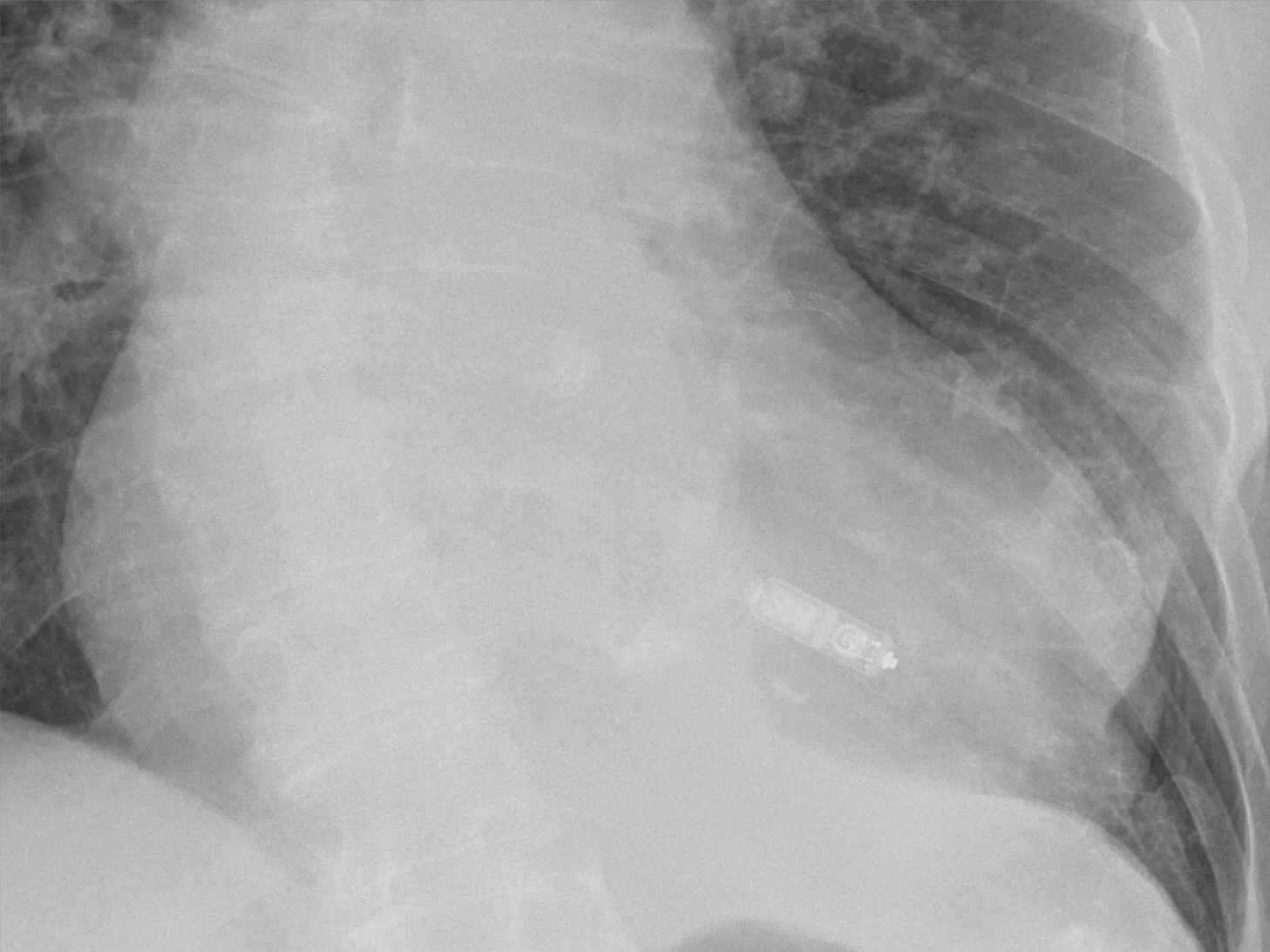
The payoff, in radiograph. A Micra leadless capsule inside a 95-year-old’s ribcage — miniaturization that only exists because the seal holds.Hellerhoff, CC BY-SA 4.0, via Wikimedia Commons
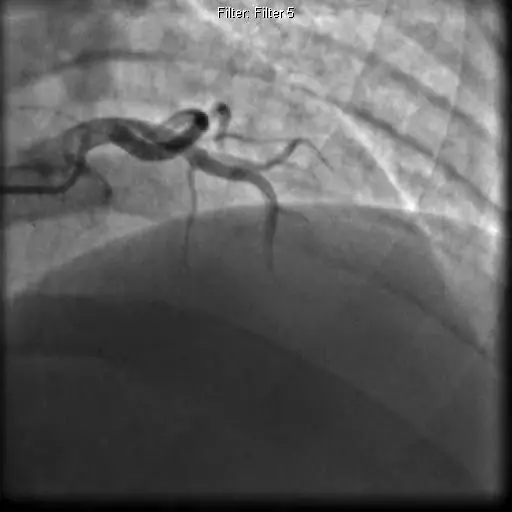
Coronary angiography
Given an easy road and a hard one, he kept choosing the hard one — because he had spent his career building the tools that made it survivable.

ACT II
The Craft
Light as a precision tool — heat exactly where the joint is.
Industrial laser cutting — a glowing kerf
The one-sentence physics
Deposit energy at the interface — and take the beam away before the heat can spread.
Every laser-joining patent in the corpus is a variation on that sentence. Two knobs make it possible: where the light is absorbed (a wavelength-versus-bandgap question) and how long the pulse lasts (a diffusion-length question). Master both and you can fuse a sapphire window to a titanium can without heating either part enough to warp it.
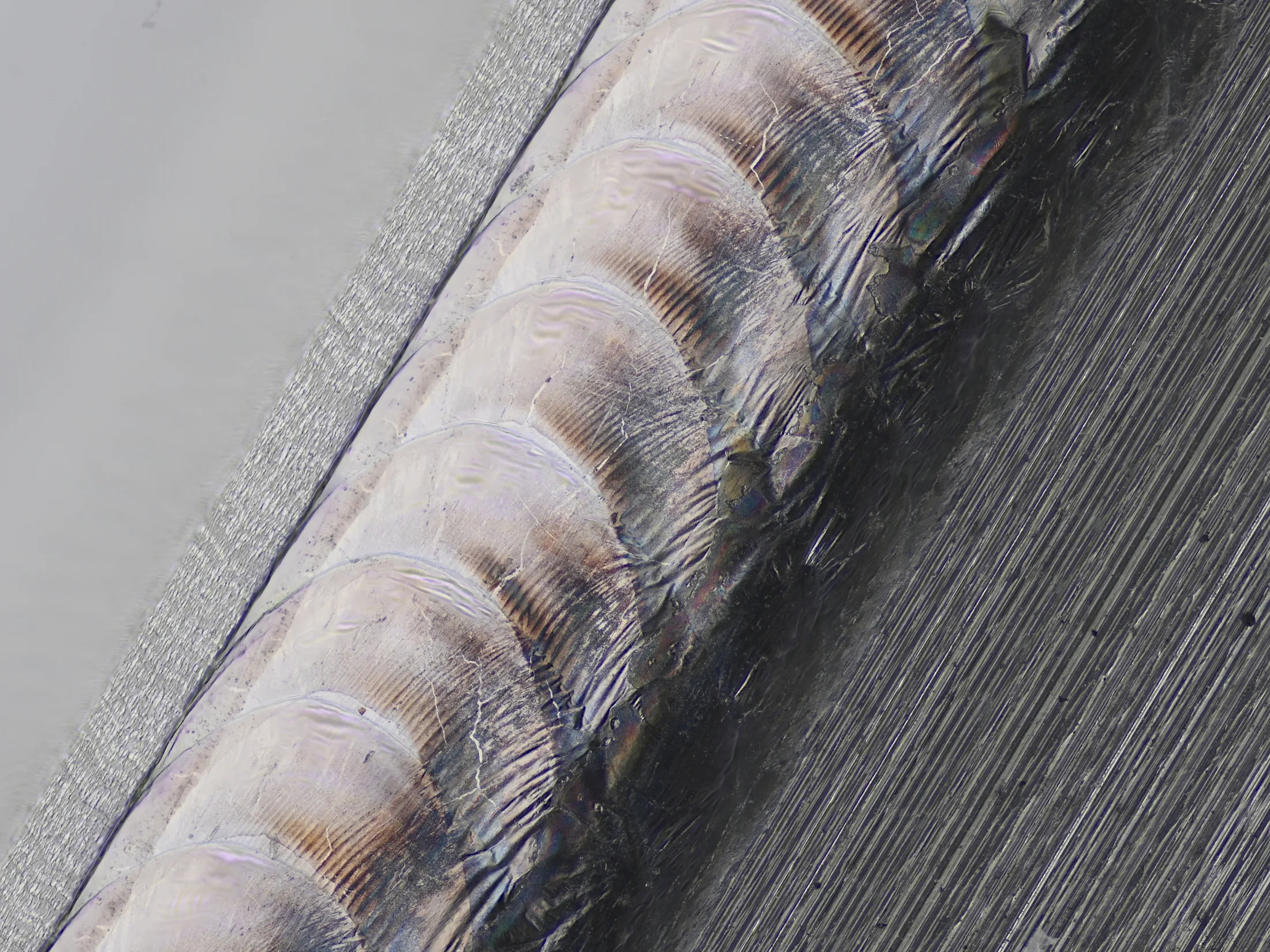
The craft, executed. A focus-stacked macro of an overlapping pulsed laser weld seam, hermetically sealing a metal enclosure.Photo: Phiarc, via Wikimedia Commons, CC BY-SA 4.0
 Archive
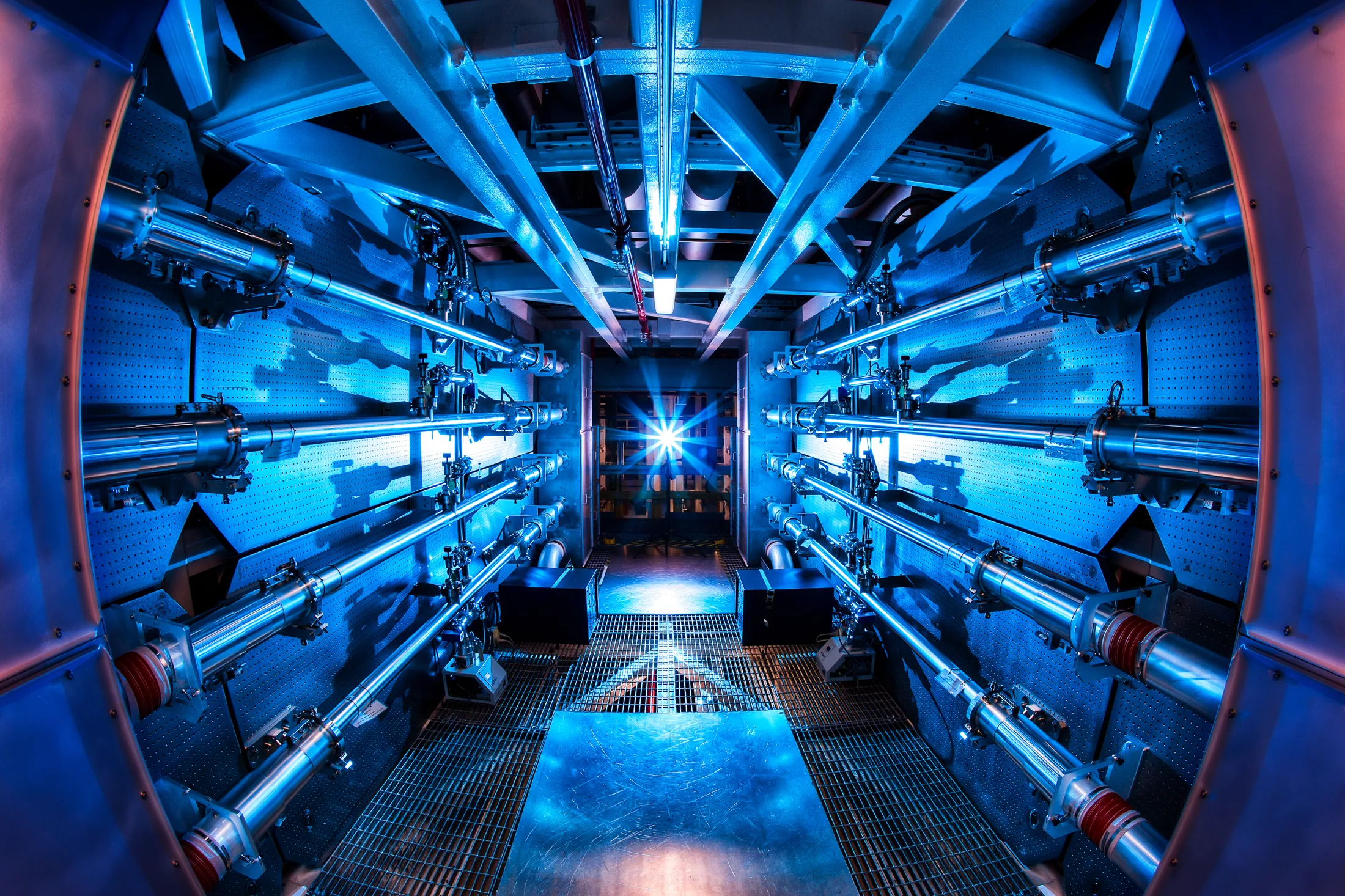
 Cathedral scale. The National Ignition Facility preamplifier bay — the physics this line miniaturizes to a weld under a micron.Photo: Lawrence Livermore National Laboratory, via Wikimedia Commons, CC BY-SA 3.0
The finished bond: sapphire fused to titanium across less than 1000 nanometers.
Then the industry’s center of gravity moved — from stimulating the body to reading it.
ACT III
The Body
Teaching the machine to feel a footstep — then to read the blood.
A beating heart, rendered
The problem statement
A rate-responsive pacemaker must know when its patient is moving.
The sensor of choice was a piezoelectric cantilever — a tiny diving board that makes voltage as it flexes with motion. The trouble: prior-art beams were so fragile that dropping the device a few feet could snap them. The answer, US 5,885,471, was a beam-stop that catches the beam just short of the deflection that would fracture it.
It is the most-cited patent in the whole corpus — 203 direct citations, 30 citing patent families — and its descendants taught the accelerometer to be survivable and mass-producible, landing dead-center in Medtronic’s own piezo-to-accelerometer transition.
A battery you can neither recharge nor switch off — its discharge curve fixed at the moment the atoms were made.
ACT IV
The Power
Decay as a battery — microwatts, for decades, asking nothing.
A Wilson cloud chamber — radiation made visible
The problem statement
The microwatt-for-decades load has only one power source set by physics, not chemistry.
A betavoltaic is a solar cell whose sun is inside: beta electrons spray electron–hole pairs into a semiconductor; a junction’s field separates them into current. The corpus’s move (US 10,096,393) is to abandon flatness — interpenetrate source and converter as a coated sponge, so every atom of fuel sits within a beta-range of a collector and almost no energy is wasted.
 Archive
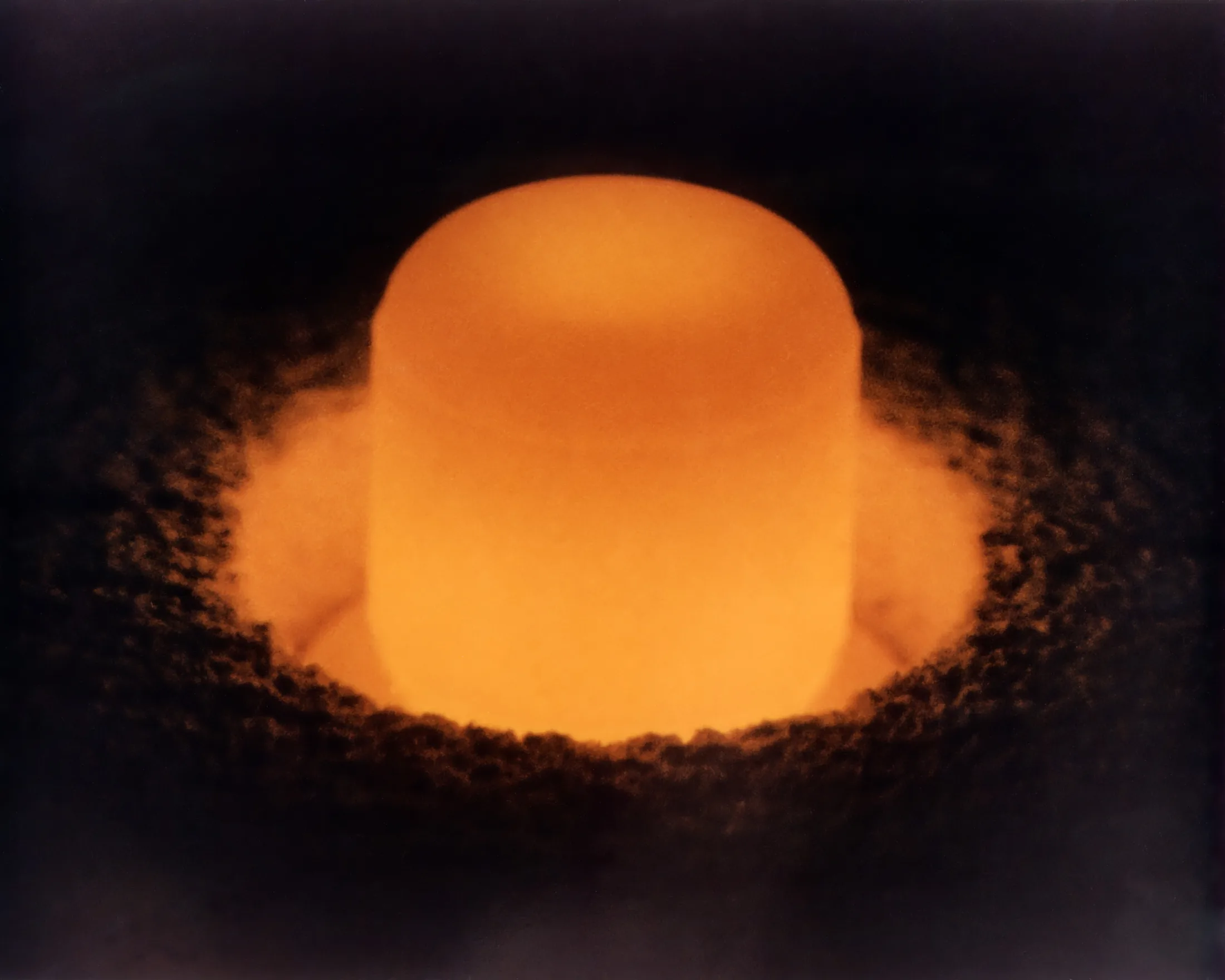
 Matter paying out energy. A plutonium-238 oxide pellet glowing under its own decay heat — the thermal cousin of the corpus’s beta cells.U.S. Department of Energy, public domain, via Wikimedia Commons
Thirty-three years, one layer down. This is where he stands.
ACT V
The Legacy
Six lines of work, cited by the field he built beneath.
High-voltage sparks on black
His most-cited work is drawn on by Boston Scientific, BIOTRONIK, Verily, Lockheed Martin and IBM — companies reaching for the enabling hardware he spent a career perfecting one layer beneath the therapy.
The programme